Dwarf Japanese Maple Root System: Depth and Invasiveness
Slide your fingers into the soil under an old Japanese maple and you will feel a dense mat of hair-fine roots lying just below the surface, pale and tangled and surprisingly close to the mulch. It is one of the best surprises in the garden, and it tells you most of what you need to know.
That habit comes from the plant's home. Acer palmatum is native to southeast Korea and central and south Japan, where it grows in dappled shade, and its roots work the top layer of soil where moisture and organic matter collect.
Below, you'll find out all about the dwarf Japanese maple root system, including how deep and wide it runs, whether it is invasive, how it behaves near paving and pipes, and what happens when it lives in a pot. For a plant this small, the roots are small too, and that is good news for your patio and your plumbing.
How a Dwarf Japanese Maple Builds Its Fine Roots
Lift the mulch beside a young 'Crimson Queen' and look at what is actually holding it in the ground. You will not find one thick anchor plunging down. You will find a spreading web of thin roots, many no thicker than a thread, branching again and again as they fan out through the top of the soil.
Fibrous Roots, No Taproot
A dwarf Japanese maple grows what we call a fibrous system. A few woody roots leave the base of the trunk and run outward, and from them come thousands of fine feeder roots that do the real work of drinking. The woody roots stay thin and short because there is so little tree above them to hold up.
This suits the plant's origins. A tree that grows in dappled shade under taller canopy does not need to chase water far down, because the surface layer stays moist and rich. The roots simply spread out where the supply is.
Why the Top Few Inches Matter
Fine roots need air as much as water, so they gather where the soil is loose and full of organic matter. UNH Extension notes that Japanese maples grow best in well-drained, acidic soil that is high in organic matter, and the root system explains why. Heavy, packed soil smothers the feeders, and bone-dry soil strands them.
Because the roots sit so close to the surface, they are the first thing to dry out in a hot spell. The leaf edges show it before anything else does, which is why a steady watering routine matters more for this plant than for most shrubs.
Slow Roots for a Slow Plant
Extension sources describe Japanese maples as slow-growing, and the roots keep that pace. A newly planted dwarf spends its first seasons knitting fine roots into the surrounding soil before the top growth takes off. If the branches seem to do little in year one, the work is going on below, so resist the urge to fuss with fertilizer or dig around to check.
Shallow, Fibrous and Surprisingly Compact Below Ground
If you sliced a trench beside a mature dwarf and measured, the root mass would most often bottom out at about 12 to 18 inches. People expect a tree to anchor itself with something deep, but nothing about a plant that stands 3 to 8 feet tall calls for it.
Three things keep the system shallow. The canopy is small, so the roots have little to support. The plant is slow-growing, so it adds root mass slowly, year after year. And the best air and moisture sit near the surface, so that is where the fibers concentrate.
The table sets a dwarf beside the full-size species. UF/IFAS gives the species as 10 to 20 feet tall, and some trees go higher, so the roots of a full-size tree have far more to do.
| Trait | Dwarf (such as 'Crimson Queen') | Full-size species |
|---|---|---|
| Height | About 5–8 ft | Up to 25 ft |
| Canopy width | About 5–8 ft | 10–25 ft |
| Root depth | About 12–18 inches | Ask your local extension service |
| Root spread | About as wide as the canopy | Much wider, in line with the canopy |
Soil changes the picture a little. In compacted clay, roots stay even closer to the surface because there is little air below, while in loose, humus-rich ground they may go somewhat deeper. Either way, a dwarf never needs a deep hole. A wide, loosened planting area does far more for it than depth.
Shallow also means exposed. A spade pushed in near the trunk cuts straight through the feeding layer, so skip the hoe and the bulb planting inside the canopy. Mulch protects those roots far better than any cultivating ever will.
Spread of a Dwarf Japanese Maple Beyond the Drip Line
Pour a bucket of water at the outer tips of the branches and you are watering right over the busiest roots. In a dwarf, the root mass spreads only about as wide as the canopy, and in loose soil it may reach a little beyond. 'Crimson Queen' spreads 1.5 to 2.5 meters, which is about 5 to 8 feet.
That is a modest footprint. A full-size Japanese maple can spread 10 to 25 feet, so a dwarf's roots cover a small fraction of the ground.
Where to Water and Mulch
The trunk is the worst place to put the hose. Water in a ring that runs from about halfway out under the canopy to just past the drip line, where the fine feeders actually are. Lay mulch across the same ring, but keep it from piling against the bark.
Planting Near the Roots
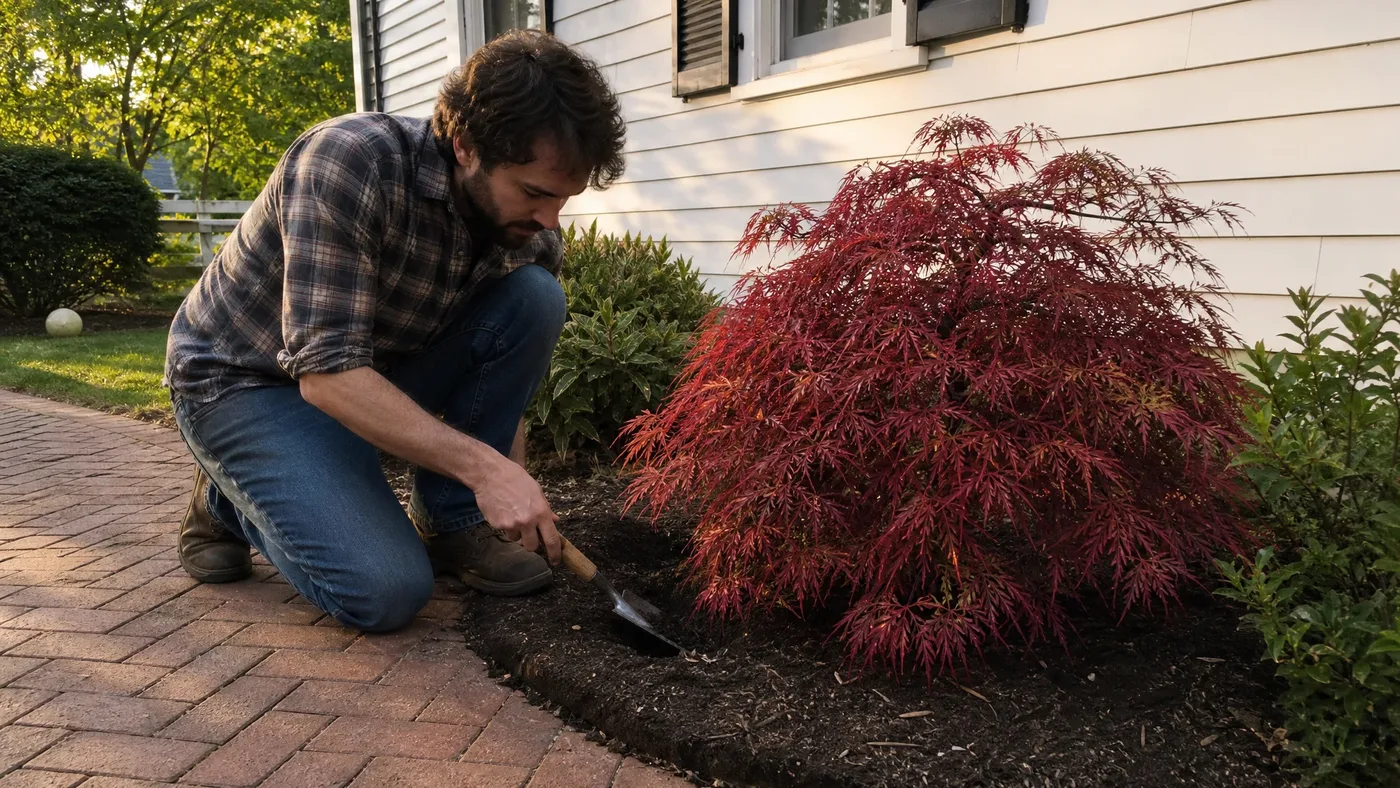
Underplanting works well if you respect that shallow layer. Choose small, shallow-rooted companions and set them with a hand trowel rather than a spade. Avoid digging large holes inside the drip line, and keep thirsty turf from creeping up to the trunk, since it competes for the same top few inches of soil.
Moving an Established Dwarf
A compact root mass is a gift if you ever need to relocate a plant. Because the roots sit near the surface and stay within the canopy width, a dwarf lifts with a manageable ball and a modest hole. Do the move while the plant is dormant, keep the ball intact and moist, and replant at the same depth it grew before.
Is a Dwarf Japanese Maple Root System Invasive?
One of the most common questions we get is whether the roots will run under the lawn and pop up somewhere else. They will not. A dwarf's roots are thin, fibrous and tied closely to the plant's own footprint, and they do not travel across a yard looking for new ground.
There is a second meaning of invasive, and it is worth being exact about it. NC State notes that the species self-seeds easily and can become weedy in the landscape, and lists it as invasive in Virginia and DC. That spread is by seed, not by roots. Duke's tree guide, in contrast, says the species rarely escapes to suburban woodlands.
The two statements fit together. A tree can seed itself in a few regions and still keep a tidy, harmless root system. If seedlings show up under your dwarf, they are small, shallow and easy to pull, and a quick check each spring keeps them from settling in.
What we tell customers is simple: the roots stay home. If you live where the species is listed, check with your local extension service. The differences between dwarf and full-size Japanese maples are mostly about scale, and root scale follows canopy scale.
Roots Meeting Paving, Pipes and Foundations
Picture a dwarf planted beside a flagstone path. After a few years, a few fine roots will have threaded into the sand under the edge stones. They do not lift anything, because heaving takes thick woody roots, and a dwarf never grows them.
The old rule to keep every maple far from the house comes from large trees, and it is wrong for a plant this size. What matters is the canopy, which sets how much room the plant needs. The distances that apply to a dwarf are covered in our guide to planting close to your house.
Pipes work the same way. Fine roots follow moisture, and a leaking joint will draw roots from any plant. Keep a dwarf away from known leaks and call your local utility locating service before you dig.
The reverse risk is the one worth watching. The roots are not a danger to paving, but paving work is a danger to the roots. Trenching for a new edge, compacting a base or pouring concrete inside the drip line can strip the feeding layer. Keep that work outside the canopy, or plan the bed first and the hardscape around it.
- Leave room for the full mature width, 3 to 8 feet depending on the cultivar, so the canopy does not rub the wall.
- Keep the planting hole clear of buried water, sewer and gas lines you know about.
- Plant in a bed beside a path rather than in a narrow gap in paving, where roots bake and dry.
- Send downspout water away from the root zone, since constant soaking suits fine roots poorly.
A Dwarf Japanese Maple Root Ball in a Pot
Slide a dwarf out of a pot it has lived in for several years and you will see a pale, tight cylinder of roots wrapped around the wall of the container. Confined roots follow the edge, circle and fill every inch. The plants we grow in containers show this mass when you slide them out, and it is what you should see.
What Confinement Does
A pot holds less soil than the ground, so the root ball dries faster in summer and heats up in sun. In winter the roots sit above the ground and take more cold than they would in a bed. Zones 5 through 8 suit the species, but a potted tree needs extra protection, covered in our container growing guide.
Because the fine roots fill the pot so densely, the mix drains and dries unevenly. A dry ball can shed water down the sides, leaving the center parched. Young leaves are not drought tolerant, so scorched edges on a potted dwarf often point to the root ball before they point to the weather.
Checking and Repotting
Check the root ball every couple of years. If roots circle tightly or the water runs straight through, it is time to act.
- Slide the plant out while the soil is moist so the ball holds together.
- Look at the outside of the ball for circling roots.
- Loosen the outer roots gently with your fingers.
- Move up only one pot size and fill with fresh, well-drained mix.
- Water thoroughly and keep the root ball evenly moist.
The same loosening applies when you move a potted plant to the ground. Our planting guide shows how to set it in.
Small Roots, Small Footprint, Easy Neighbor
A dwarf Japanese maple keeps its roots close: a fibrous mass about 12 to 18 inches deep and about as wide as the canopy, 3 to 8 feet. That is why it is not invasive at the root, why paving and pipes can stay put around it, and why steady water and mulch do more for it than any deep digging.
Lift a small root ball out of its pot sometime and just hold it. It is dense, pale and tidy, a cool tight weave of threads that fits in your two hands and tells you almost everything about how this tree wants to live.
Dwarf Japanese Maple
Nursery-grown Dwarf Japanese Maple in sizes from 2 Gallon, shipped to your door.
From $95.85
Shop Now →Fine roots stay happiest when the soil never swings between soggy and dry, so each Dwarf Japanese Maple here is raised in dappled shade, in well-drained soil that stays evenly moist. We grow and sell top-quality trees from our own farms. If a tidy root system beside your path or patio is what you want, begin with a maple from our shop.