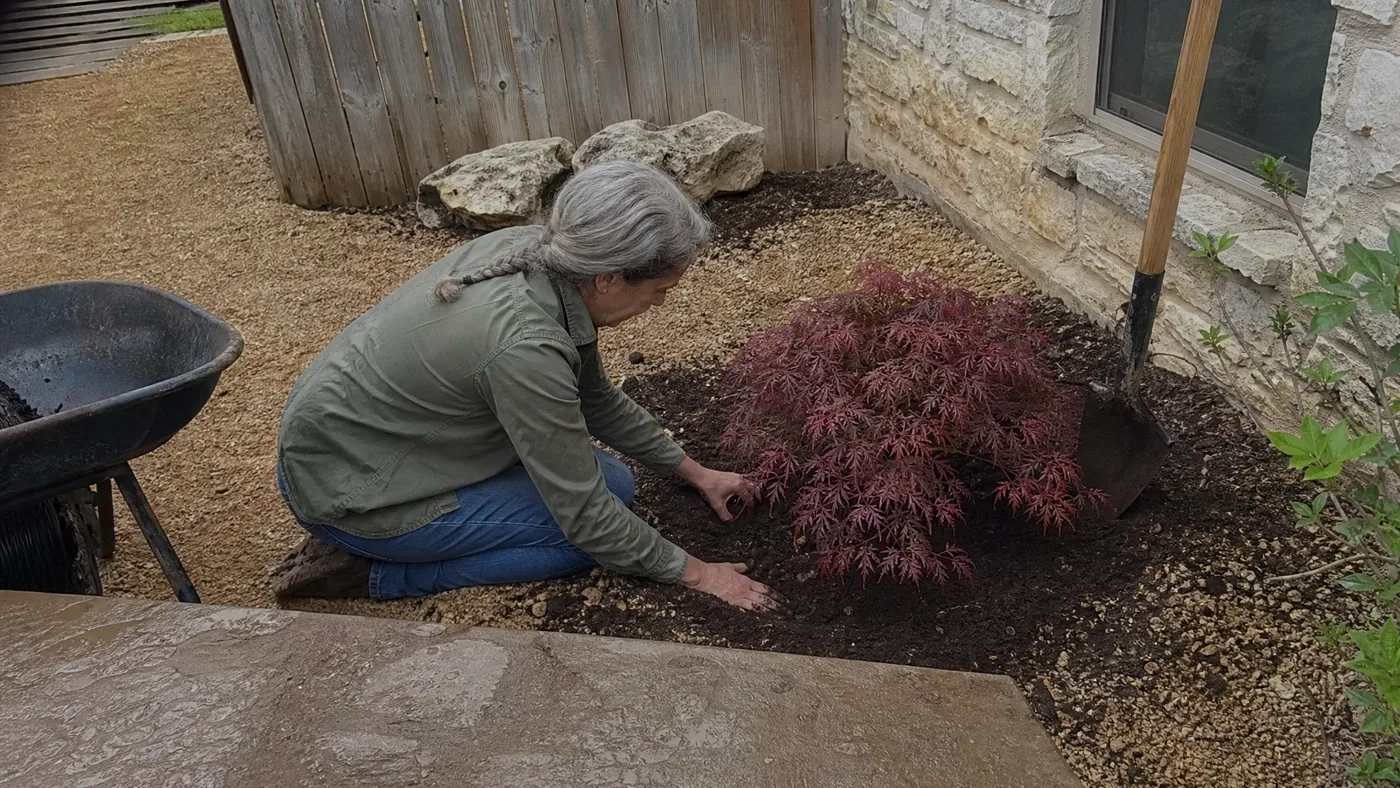
Planting a Dwarf Japanese Maple Close to Your House
Walk to the curb and turn around. A weeping maple once went in beside a porch step because the tag said it stayed small, and from the street it looked perfect that first autumn. Within a few seasons its cascade lay across the walk, and every visitor brushed past it on the way to the door.
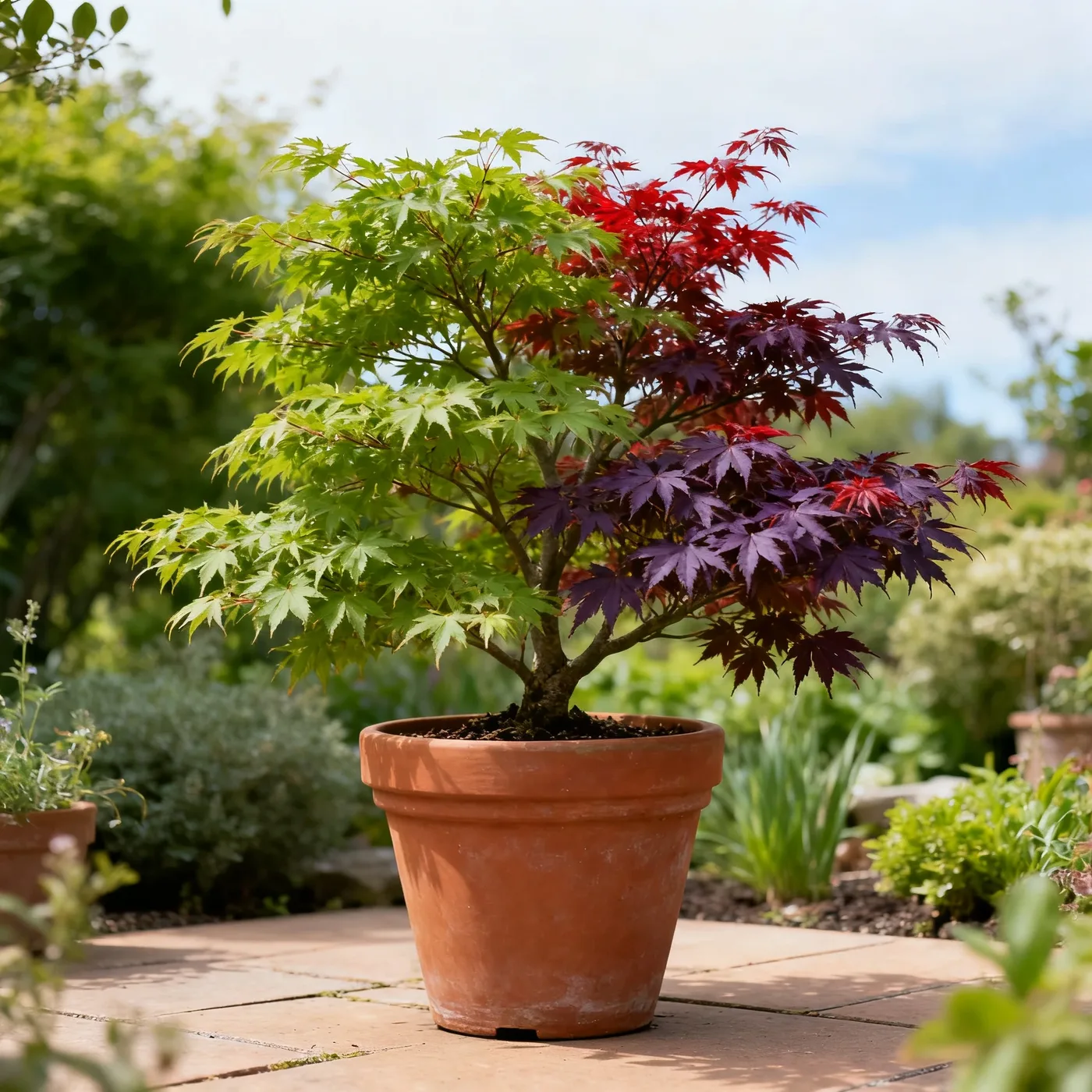
A dwarf maple stays small, but it grows slowly and lives in one spot for decades, so a placement mistake beside a house stays with you. Put it where the wall bakes it and the leaf edges brown every summer. Put it where it fits and it frames your entry for years with almost no cutting.
Read on for the sightlines and sun path, distances by mature size, entry beds, how a north wall and a south wall differ, the planting hole beside concrete, and the leaf signs that tell you whether the spot is working.
The Whole Yard Around a Dwarf Japanese Maple
Start with a sketch or a phone photo taken from the curb. Mark the front door, the windows, the walk, the downspouts and the place where the driveway meets the walk. A Dwarf Japanese Maple is a focal plant, and a focal plant needs one clear spot to be seen from. That spot is usually the corner of the entry bed your eye reaches right after the door itself.
Follow the Sun Across the Front of the House
Check the wall you have in mind at mid-morning, at noon and again around 3 p.m. Extension sources name dappled shade as the ideal for a Japanese maple, and the red and purple cultivars such as 'Bloodgood' need some sun to hold their dark color. So you want bright morning light and a break from the hot afternoon. A porch roof, a neighboring tree or the house itself can give you that break.
Also feel for wind. The gap between two houses and the corner of a gable both funnel air, and this tree needs protection from drying winds. Wind pulls moisture out of thin leaves faster than the soil beside a wall can replace it.
Check Sightlines and Hardware
Stand inside at the front window and look out. A dwarf that blocks the view from the living room, or the view of the driveway when you back out, is in the wrong place however good it looks from the street. Keep it clear of the hose bib, the electric meter, the dryer vent and the air conditioner condenser, because all of them either need access or blow hot air across the leaves.
Then think about the backdrop. Cutleaf and red-leaved maples read best against plain siding or pale stone. A burgundy leaf against red brick disappears, while the same leaf against cream or gray siding glows, especially in fall.
Foundation, Walkway and Eaves Distances by Mature Size
A dwarf can sit much closer to the house than a full-size maple because its mature spread runs about 3 to 8 feet, against the 15 to 20 feet a full-size tree needs. UF/IFAS puts the species at 10 to 20 feet tall, and the dwarfs are a different animal. For the plant-to-plant side of this, our guide on how big dwarf Japanese maples really get covers it. Here we only measure from structures.
Our rule is half the mature spread, plus a foot for air movement and paint access. 'Crimson Queen' reaches 1.5 to 2.5 meters (about 5 to 8 feet) in both height and spread, which puts it at roughly 4 to 5 feet from the wall. Use this table as a starting point.
| Mature size | Spread | From foundation | Walkway and eave notes |
|---|---|---|---|
| Smallest dwarfs | 3 to 5 feet | About 3 feet | Stays off a standard walk and well below the eave |
| 'Crimson Queen' size | 5 to 8 feet | 4 to 5 feet | Keep the canopy edge back from paving |
| Weeping cutleaf | About 8 feet | 5 feet | Cascade reaches the ground, so give it the full width |
| Full-size maple | 15 to 20 feet | Not near the house | Needs a lawn, not a bed |
For walkways, measure from where the canopy will end, not from the trunk. Weeping forms hang to the ground, so a plant set 3 feet from a path with a 4-foot spread is already leaning over it. Stay clear of the roof drip line too. Runoff and sliding snow in zones 5 and 6 break the thin branches, and the soil under a drip line swings between soggy and dry.
Entry Beds and Front-of-House Plantings
Set the tree at the corner of the entry bed or beside the steps, not directly in front of the door. A weeping dwarf spills outward, and the cutleaf Dissectum type forms a mound to around 2 meters tall and 2.5 meters wide, roughly 6 feet by 8 feet. Centered on the door, it would hide the very entry you want to frame. One of the most common questions we get is whether a dwarf can go right beside the front steps. It can, if the cascade has the full 8 feet.
Patience matters here, because the cutleaf type takes 10 to 20 years to reach full size. Plant the bed for the tree you will have in a decade, not the one you bring home. Fill the gaps with low perennials or a small shrub you can move later, and keep them back from the trunk. Japanese maples do best when they do not compete with the plants around them.
For more ways to combine a dwarf with stone, grasses and shade plants, see our landscaping ideas for dwarf Japanese maples. Near the door, keep it simple: one maple, a layer of mulch, and one or two low companions. The tree is the show.
Shade Side and Wall-Reflected Heat Pull Different Ways
A shaded wall and a sunny wall ask for different cultivars and different spacing, even at the same distance from the house. Zones matter too. UNH Extension says Japanese maples perform well in zones 5 and 6 if planted in the right location, and the right location is often the one a southern gardener would avoid.
North Walls Are Cool but Dim
A north wall gives the steady, even shade the species likes, with no hot afternoon. The trade-off is color. Red and purple cultivars need some sun to develop their dark hues, so a 'Bloodgood' or 'Tamukeyama' tucked fully against a north wall turns dull green-bronze. Put these at the corner where they catch some morning light, or choose a green-leaved cultivar for the deep shade. Our guide on sun and shade needs goes further.
South and West Walls Bounce Heat Back
Japanese maples need partial shade to prevent afternoon sun from scorching the foliage. A south or west wall adds to that, because siding, brick and pale concrete throw heat back onto the leaves. Warm walls also push leaves out early in spring, and young leaves are sensitive to frost.
If you have only a hot wall, give the tree an extra foot of distance, shade it with a taller neighbor, or move it to the east side of the entry. East walls get the morning sun that red cultivars want and shade after noon, and we send most customers there first.
Digging the Hole for a Dwarf Japanese Maple Near Concrete
The soil beside a foundation is rarely the soil of the rest of the yard. Builders backfill with whatever is on site, and it is often compacted clay mixed with rubble, scraps and a little lime from the concrete. Dwarf maples want well-drained, acidic soil high in organic matter, per UNH Extension, so ask your local extension service about testing the pH before you amend. Our guide on the best soil for a dwarf Japanese maple has the details.
Follow these steps at the wall:
- Call your local utility-locating service before you dig, and look for the edge of the footing with a probe or a small test hole.
- Mark the center at the distance from the table above, then dig the hole wide, flat on the bottom and no deeper than the ball.
- Pull out any rubble, builder's fill and stones, and break up the sides so the wall of the hole is not smooth.
- Set the tree so the top of the ball sits level with the grade. Leave no more than 1 inch of soil over the top of the ball, since these maples dislike being planted deep.
- Backfill with the soil you dug out, mixed with some compost, and water until the soil settles.
- Mulch in a ring, pulled back from the trunk and from the wall.
Grade the soil so water runs away from the foundation, and check where the downspout splashes. Our trees ship in containers with the ball intact, so you can set the height before you backfill.
Leaf Edges and Wall Heat on a Dwarf Japanese Maple
The leaves tell you within the first summer whether the spot works. The usual problems are anthracnose, leaf scorch and frost damage, and young leaves are not drought tolerant. Scorch shows as dry, crisp brown edges, and on a cutleaf the fine tips go first.
Reading the Pattern
We often see crisp edges only on the side facing the wall. That points to reflected heat. If the browning runs evenly around the whole tree, suspect dry soil instead. Scorch on a cutleaf can come from lack of soil moisture or too much exposure. Blackened, drooping tips on new leaves in spring are frost, not heat, and usually follow a warm spell that pulled the leaves out early.
What to Change
Fix water first, because it is the easier cause. Soak the soil slowly and deeply, then let the top inch dry, as in our guide to watering a dwarf Japanese maple. If the edges keep browning, hang shade cloth on the wall side through July and August and plan to move the tree in fall. Moving a three-year-old dwarf costs far less than watching it scorch for ten summers.
A Dwarf Japanese Maple That Stays Where You Put It
Place it by the numbers: half the mature spread plus a foot from the wall, a full width for a weeping cascade, and clear of the drip line and the hot exhaust of vents. Choose the wall for the cultivar, with east walls and the corners of north walls first, and plant it with the top of the ball level with the soil. Do those things and a Dwarf Japanese Maple stays in scale beside your door for decades.
Read the leaves in the first summer, adjust the water or the shade, and trust the plant. If it is right, you will not be pruning to hold it back.
Dwarf Japanese Maple
Nursery-grown Dwarf Japanese Maple in sizes from 2 Gallon, shipped to your door.
From $95.85
Shop Now →Dwarf Japanese Maple is happiest by a house wall when its roots stay cool and its leaves are shaded from the harshest sun, which is why our growers give each tree dappled shade, soil that holds steady moisture yet drains well, and shelter from drying wind. All of our trees, shrubs and grasses are top-quality plants that come from our own rows, never from someone else's. Once you have picked the wall and measured the space, come and see what we have growing.