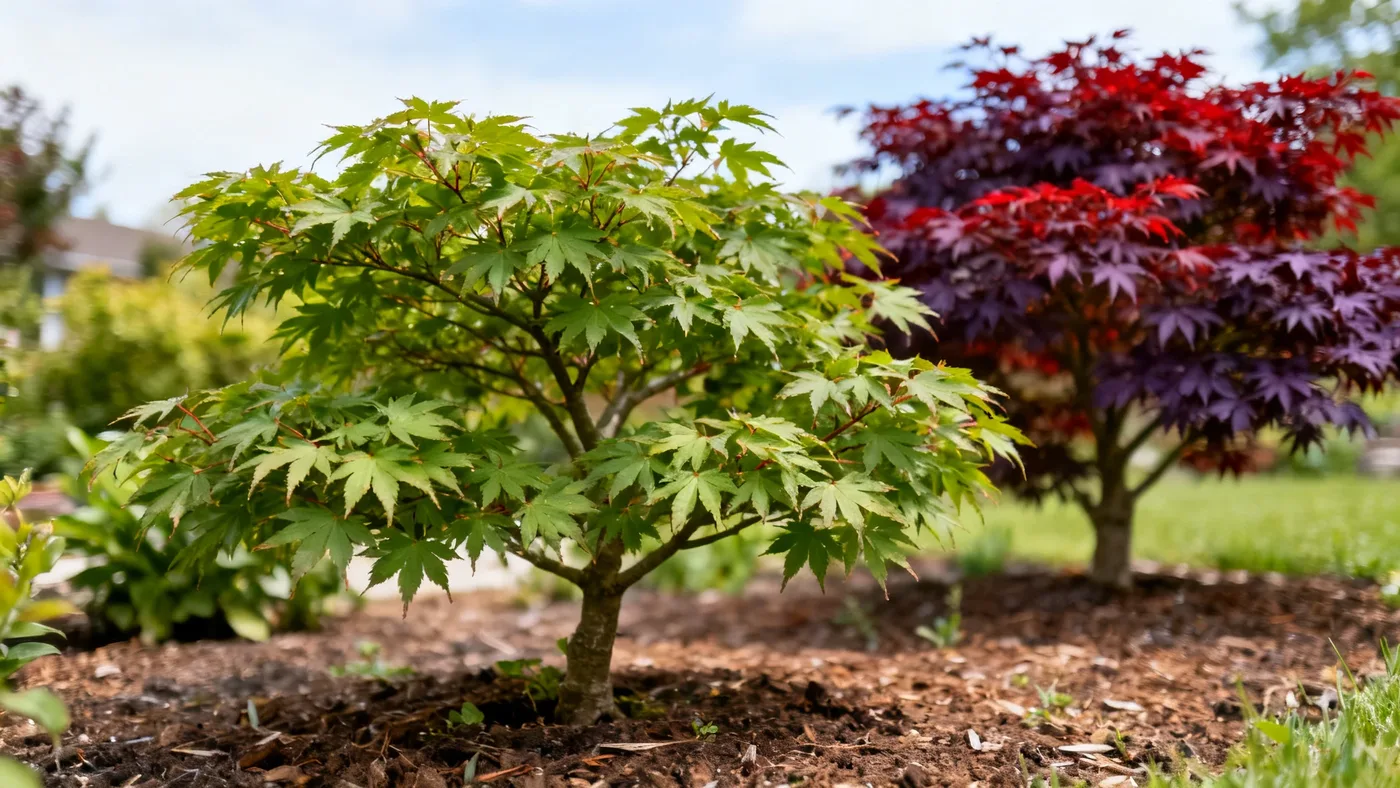
How Big Do Dwarf Japanese Maples Really Get?
Dwarf Japanese maple size is one of the most common questions home gardeners ask when planning landscape changes. "Dwarf" can mean different things to different growers, and without clear information, you might end up with a plant that overtakes a small space or falls short of your design vision. This guide answers the practical questions about how large these maples actually grow, how fast they get there, and how to plan your garden around their mature size.
General Sizing Questions
How big do dwarf Japanese maples really get?
Dwarf Japanese maples typically reach 4 to 8 feet in height at maturity, with a spread of 4 to 8 feet, though this varies significantly by cultivar. Weeping and mounding forms tend toward the smaller end (4 to 6 feet tall), while upright dwarfs can reach 8 to 10 feet. Most cultivars commonly found at nurseries mature at 5 to 6 feet tall with a similar or slightly wider spread.
What's the difference between a dwarf cultivar and a standard Japanese maple?
Full-size Japanese maples often grow 15 to 25 feet tall, while dwarf cultivars top out at 4 to 10 feet depending on variety. This genetic difference is deliberate: dwarf cultivars like 'Tamukeyama' and 'Shaina' were selected and bred specifically for compact growth over many generations. The size difference means dwarf varieties fit foundation plantings, small yards, and container gardens where standard maples would quickly overwhelm the space.
Will my dwarf Japanese maple grow wider than it is tall?
Many dwarf Japanese maple cultivars do grow wider than they are tall, especially weeping and mounding forms. A tree that reaches 6 feet tall might spread 7 to 8 feet wide at maturity, so width becomes as important as height when planning placement. Check the specific cultivar's growth habit when selecting; upright forms are more columnar, while dissected-leaf varieties often develop broader, more cascading branching.
How does 'Bloodgood' compare to other dwarf cultivars in size?
'Bloodgood' is a reliable upright dwarf that typically reaches 6 to 8 feet tall with similar width at maturity. It's a popular choice because its size is predictable and manageable in most suburban landscapes. 'Crimson Queen', by contrast, is a weeping form that stays more compact, often reaching 5 to 6 feet tall but spreading 6 to 8 feet wide, making it ideal for focal plantings.
How big does 'Tamukeyama' actually get?
'Tamukeyama' is a deeply dissected weeping cultivar that typically reaches 5 to 6 feet in height with a wide, spreading form at maturity. This variety is slow-growing and more delicate-looking than 'Bloodgood', making it a favorite for Japanese gardens and specimen plantings. Its graceful, weeping habit makes it appear smaller than it actually is, which is one reason gardeners love it despite its 6 to 8-foot eventual spread.
Is 'Shaina' truly the smallest dwarf cultivar?
'Shaina' is among the most compact dwarf cultivars available, reaching around 6 to 8 feet tall at maturity with proportionately narrow width. Its fine foliage and slow growth habit make it an excellent choice for tight spaces, containers, and refined garden designs. If space is severely limited, 'Shaina' is worth seeking out, though most dwarf varieties offer adequate size control for typical residential properties.
Growth Rate and Timeline
How fast do dwarf Japanese maples grow?
Dwarf Japanese maples are slow growers, adding approximately 6 to 12 inches of growth per year under typical conditions. This slow pace means your young plant will take 5 to 10 years to reach a mature, well-shaped form that fills its intended garden role. Slower growth is actually a benefit: it gives you time to refine pruning, relocate plants if needed, and enjoy the transition without abrupt landscape changes.
How long until my dwarf Japanese maple reaches full size?
Plan for 5 to 10 years before your dwarf Japanese maple develops a mature, fully-shaped form, though it will be attractive and useful much sooner. A tree adding roughly 12 inches annually reaches its final 6-foot height in 5 years; one averaging 6 inches per year takes 10 years. Environmental factors like light, soil quality, water consistency, and regional climate all influence the exact timeline.
Will a young dwarf Japanese maple look sparse at first?
Yes, young plants often appear thinner and less full than their mature forms, especially in the first 2 to 3 years after planting. Light pruning and consistent watering encourage branching and density as the plant establishes. By year 3 to 4, you should see noticeably fuller structure that better matches the mature cultivar's signature branching pattern.
Does sunlight affect how large a dwarf maple grows?
Sunlight influences growth rate and overall plant vigor, though it doesn't change the genetic mature size much. Plants in part shade (morning sun with afternoon protection) often grow slightly slower than those in full morning sun, which is actually beneficial if you want to delay reaching maximum size. For more information on optimizing light and other growing conditions, check our dwarf Japanese maple care guide.
Spacing and Planting Distance
How far apart should I plant dwarf Japanese maples?
Space dwarf Japanese maples 3 to 6 feet apart, depending on the mature spread of your chosen cultivar and your design goals. For a quicker, fuller landscape effect, plant at the closer end (3 feet); for individual specimen plantings or if you plan annual pruning for air circulation, use 5 to 6 feet. Closer spacing works if you're comfortable with light thinning as they mature; wider spacing keeps long-term maintenance minimal.
How deep and wide should a planting hole be?
Dig a planting hole roughly the same depth as the root ball and 1.5 to 2 times wider to encourage root spread into surrounding soil. For a tree in a 3-gallon nursery container, this typically means a hole 12 to 14 inches deep and 18 to 24 inches wide. Our guide to planting dwarf Japanese maple correctly covers step-by-step instructions and common mistakes to avoid.
Will my dwarf maple grow larger than the spacing suggested?
Yes, mature spread can exceed the 3-foot minimum spacing, so branches will eventually touch neighboring plants. This is normal and not usually a problem if neighboring shrubs are also slow-growing or if you're comfortable with light annual pruning. For landscape designs where you want clearly defined individual plant shapes, use the wider 5 to 6-foot spacing instead.
What's the minimum space needed for just one dwarf Japanese maple?
A single dwarf Japanese maple needs at least a 6 to 8-foot diameter open area at maturity to develop its natural branching structure without crowding. This accounts for the 4 to 8-foot mature spread plus a buffer for air circulation and visual breathing room. In small yards, you can manage a tighter fit with annual pruning, though the tree performs best with space to spread naturally.
Container Growing
Can dwarf Japanese maples grow in containers?
Yes, dwarf Japanese maples are well-suited to container culture and actually thrive in pots with good drainage and consistent moisture. Containers slow growth slightly and help control final size, making them ideal for patios, courtyards, and small gardens. A 15 to 20-gallon container is appropriate for mature plants; start with a #1 or #3 nursery pot and upsize as the tree grows over several years.
How big does a dwarf maple get in a pot compared to in-ground?
Container-grown trees typically reach about 80 to 90 percent of their in-ground size due to mild root restriction and easier management. A 'Bloodgood' that reaches 8 feet tall in-ground might mature at 6 to 7 feet in a large container, which is actually an advantage if you're looking for a more compact specimen. The trade-off is more frequent watering and occasional root pruning to maintain vigor over time.
What size container do I need for a dwarf Japanese maple?
Start with a #1 or #3 container from a nursery (roughly 2 to 3 gallons), then graduate to a 10 to 15-gallon pot as the tree grows over the first few years. At maturity, a 20-gallon container is ideal for long-term health and stability. Adequate drainage holes are essential; use a rich, well-draining potting mix designed for woody ornamentals or plants that prefer slightly acidic soil.
Do container-grown trees need winter protection?
Yes, in colder zones (USDA 5 to 6), container-grown dwarf Japanese maples should be moved to a sheltered location like a garage or cold frame during winter, or wrapped with burlap to insulate the roots. In-ground plants are more cold-hardy because soil insulates the roots; exposed container roots freeze more easily. Some cultivars thrive in zones 5 to 8, with certain selections to zone 9 with afternoon shade, so verify your specific variety's cold tolerance.
Size Control and Pruning
Can I keep a dwarf maple smaller through pruning?
Yes, light pruning of new shoots during the growing season encourages branching without opening the canopy excessively. Late fall to mid-winter dormant pruning of dead or crossing branches maintains shape and health. However, aggressive pruning that removes extensive foliage weakens the tree and should be avoided; the best approach is choosing the right cultivar for your space at planting time.
When is the best time to prune a dwarf Japanese maple?
Prune dwarf Japanese maples in late fall to mid-winter while fully dormant to minimize sap bleed and reduce disease entry points. Spring pruning is also acceptable, though it invites sap flow that can attract insects. Avoid pruning in late summer or early fall, as this stimulates tender new growth that cold weather can damage.
Will pruning harm my dwarf maple's growth rate?
Light pruning (removing 10 to 15 percent of branches) doesn't reduce overall growth rate significantly and often improves branching density. Heavy pruning that removes more than 30 percent of the canopy slows recovery and can stress the tree, so reserve that for dead-wood removal only. For a dwarf variety, minimal pruning is almost always the right approach since the cultivar was selected for its natural, slow-growing, manageable habit.
Comparison and Special Considerations
How do dwarf Japanese maples compare to dwarf Japanese holly or other dwarf shrubs?
Dwarf Japanese maples are typically taller (4 to 8 feet) and slower-growing than many other compact shrubs, offering more vertical presence and dramatic fall color. Pairing them with lower-growing companions like dwarf azaleas or hostas creates visual layering and makes the maple appear even more striking. Their slow growth also means they integrate naturally with other established landscape plants over years.
Are there any dwarf maples smaller than the standard dwarf cultivars?
There are some ultra-compact cultivars and dwarf selections, but they are less commonly available through standard nurseries. If you're working with severely limited space, 'Shaina' remains one of the most compact readily available options. Specialty nurseries and mail-order suppliers sometimes carry even smaller selections, though stock and availability vary by season and region.
How can I predict the final size of my specific cultivar?
Ask the nursery or supplier for the specific cultivar's mature height and width at the time of purchase; this information is often on the plant tag or label. If unavailable, contact your local extension service or the nursery directly, as staff are usually familiar with cultivar performance in your region. Knowing the exact cultivar name (not just "dwarf Japanese maple") is the most reliable way to predict final size accurately.
Quick Reference: Dwarf Japanese Maple Size at a Glance
| Aspect | Typical Range | Notes |
|---|---|---|
| Mature Height | 4 to 8 feet (upright to 8 to 10 feet) | Weeping forms stay 4 to 6 feet; upright dwarfs reach 8 to 10 feet |
| Mature Width | 4 to 8 feet, often wider than tall | Wider for mounding and weeping forms; narrower for upright cultivars |
| Annual Growth Rate | 6 to 12 inches per year | Slow and predictable; varies by cultivar and local conditions |
| Years to Full Size | 5 to 10 years | Depends on site conditions and specific cultivar; exact timeline varies |
| Planting Spacing | 3 to 6 feet apart | 3 feet for faster landscape fill; 5 to 6 feet for individual specimens |
| Container Pot Size | #1 to #3 initially; 15 to 20 gallons at maturity | Good drainage essential; slightly smaller final size than in-ground |
| USDA Hardiness Zones | 5 to 8 (some cultivars to 9 with afternoon shade) | Verify cultivar hardiness; zone 9 requires afternoon shade protection |