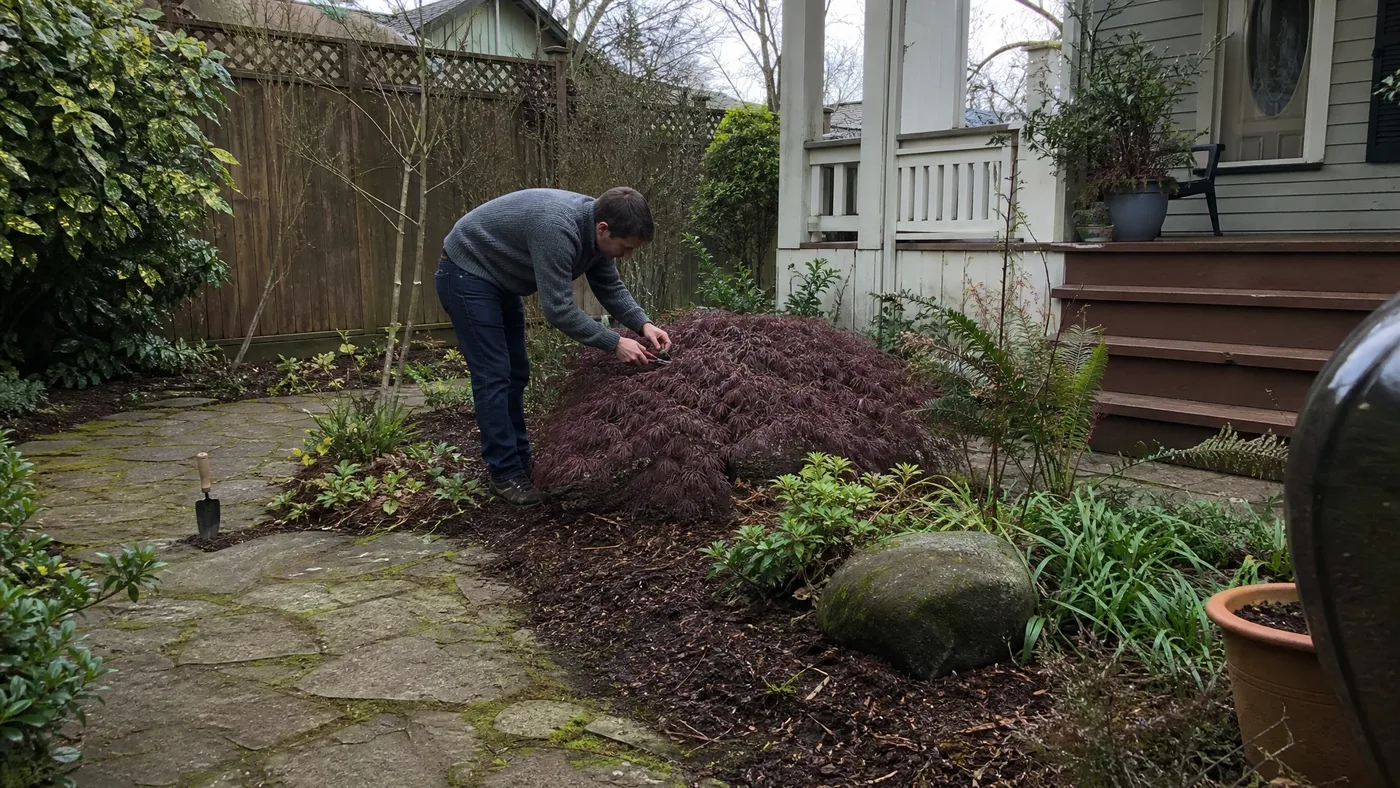
How to Keep a Dwarf Japanese Maple Small for Decades
Holding a Dwarf Japanese Maple at about four feet for ten years costs a few minutes of light pruning each summer, a root trim every couple of years if the tree lives in a pot, and the discipline to feed it less than you think it wants. A mismatched purchase costs far more. A tree that wants to reach 25 feet will outgrow its spot, and then you either butcher it every year or pay to remove it.
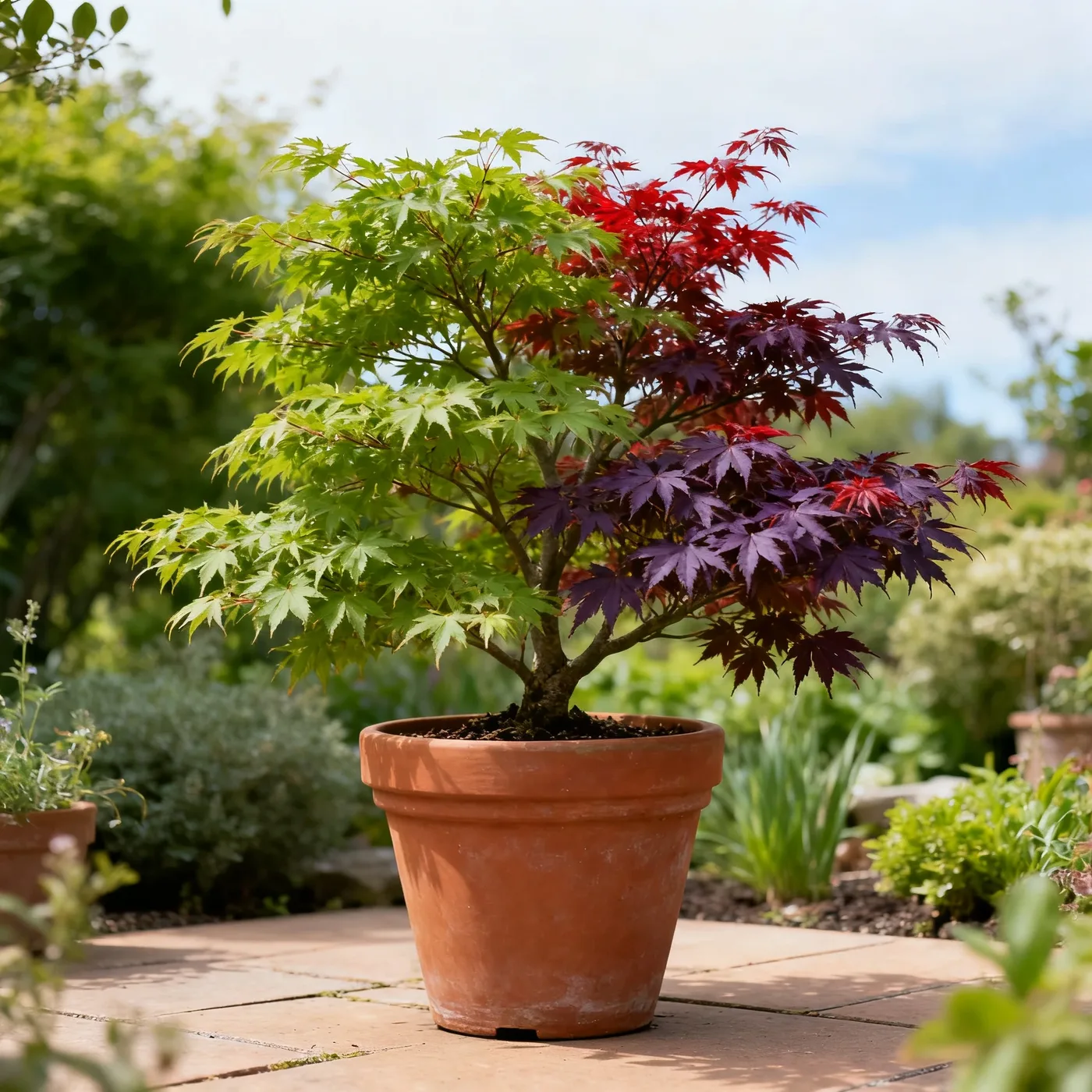
These maples grow slowly, so mistakes show up late. By the time the wrong choice is obvious, you are several seasons in and the tree has settled into the wrong place.
We'll walk you through cultivar choice and why a standard maple cannot be shrunk, then pot size and root trimming, a light pruning routine and sparing feeding, and finally a realistic timeline for the effort.
The Right Dwarf Japanese Maple Cultivar Does Most of the Work
Size control starts on the nursery bench, because genetics is the cheapest lever you will ever have and the only one that works without effort. A cultivar that adds only a few inches a year needs almost no correction. One that adds a foot a year needs correction every season for as long as you own it.
Pick slow genetics first, and treat pruning, pots and feeding as support.
What Dwarfing Means in This Plant
In Acer palmatum, "dwarf" is not a fixed height. It describes a growth rate and a habit that a cultivar passes on, usually slow extension and dense branching, and it tells you how long the tree takes to get big as much as how big it ends up.
The species itself is a small deciduous tree to 25 feet, so even the word dwarf is relative. At the true small end, 'Sharp's Pygmy' is a slow-growing, dense, truly dwarf maple with tiny leaves, and 'Shaina' is dense and compact with red foliage. Those are the cultivars that hold a size with very little help.
Cultivars That Drift Larger
The weeping, lace-leaf cultivars sit in the middle of the dwarf range, and they surprise people. 'Crimson Queen' reaches 1.5–2.5 meters, or about 5–8 feet, in height and spread.
'Tamukeyama' matches that height, but its spread runs 2.5–4 meters, about 8–13 feet, wider than tall, and it takes 10–20 years to reach maturity.
These are good trees, but they are not four-foot trees unless you work at it. Our guide on how big dwarf Japanese maples really get lays out the numbers cultivar by cultivar. Read the mature spread as well as the height, since a mound that doubles in width can crowd a path long before it gets tall.
A Standard Maple Will Never Shrink to Fit
No amount of pruning turns a standard Japanese maple into a dwarf, because the size is set by the cultivar and not by the branches. Japanese maples can reach 26 feet in fifty years under good conditions, and UNH Extension puts the group at from six to 25 feet tall.
That whole spread separates a true dwarf from a standard tree. A standard cut back every year is still a standard tree, and it keeps trying to be one.
Trying anyway has a price. Hard cuts push a flush of vigorous, upright shoots, which spoil the layered branching that makes the tree worth owning. Cuts made in the wrong season bleed sap, and that weakens the tree.
You end up with a sheared, stiff-looking plant and a chore that never ends. UNH points out that these maples are slow-growing and expensive, so a wrecked one means paying twice.
One of the most common questions we get is whether a regular maple, kept cut back, will pass for a dwarf. It will not, and it looks worse every year. Our comparison of dwarf and full-size Japanese maples shows how to tell them apart before you buy. Look for a cultivar name and a stated mature size. A tree sold with no name gives you nothing to check against.
Root Restriction in a Pot Suits a Dwarf Japanese Maple
After genetics, a pot is the strongest size control you have, because a tree can only carry as much canopy as its roots can feed. Keep the root ball confined and top growth settles at a level the container supports.
The trade-off is vigor. A potted maple makes shorter shoots and recovers more slowly from stress, and it dries out faster. Young leaves are not drought tolerant, so a restricted tree scorches sooner than one in the ground if a watering gets missed.
Choose a Pot That Caps Growth
Start with a pot only modestly larger than the nursery container and step up slowly. Repot into a slightly bigger container every couple of years, and note that long-term container trees need root pruning every two or three years.
The two jobs serve different goals. Stepping up buys room, and trimming holds size. If your aim is to hold size, trim and return the tree to the same pot. Use a heavy pot with drainage and an acidic, organic mix. Our container growing guide covers pot materials and winter placement.
Trim the Roots Every Two or Three Years
Do the work in the dormant season, and follow these steps in order.
- Water the tree well a day ahead so the roots are pliable and the ball slides out cleanly.
- Lay the pot on its side, ease the root ball out, and tease the outer roots apart with your fingers.
- Cut away circling roots and the thickest woody ones around the edge, leaving the fine, fibrous roots mostly intact.
- Refill the same pot with fresh acidic, high-organic mix, keeping the crown at its original depth.
- Water it in, set it in shade for a few weeks, and keep it evenly moist while it recovers.
Skip canopy pruning in a root-trim year. Taking from both ends at once is how a good tree stalls.
Light Pruning Suits a Dwarf Japanese Maple Best
Pruning is the tool people reach for first and the one that matters least for a slow cultivar. If your tree adds only a few inches a year, the annual job is small: dead twigs, crossing branches, and the occasional shoot that breaks the outline.
Common advice says to cut a set share off every year to hold size. We do not, because every large cut on a maple is a wound that bleeds and scars, and the slower the tree, the longer the scar stays visible.
Cut in the Right Season
Sources agree on the principle and differ slightly on the dates. Japanese maples are best pruned from July to January, since they bleed sap from cuts at other times, and summer pruning after the spring flush helps avoid heavy sap flow.
What we tell customers is to cut in summer once the new growth has hardened, and to leave anything bigger than a pencil alone. Our guide on when and how to prune goes through the cuts one by one.
What Pruning Can and Cannot Control
Here is what a light routine does and does not do for size.
- It can shorten a leader or a wide branch by cutting back to a side branch that points where you want growth, which holds height and spread gently.
- It can thin a crowded interior so the layered form stays visible and air moves through the canopy.
- It can remove one wayward shoot a year, before it becomes a limb that needs a large cut.
- It cannot lower the ceiling set by the cultivar, so a tree bred for 5–8 feet will not stay at four feet on pruning alone.
- It cannot be done in one dramatic session, because large cuts on an established maple leave scars and weaken it.
Small cuts, made yearly, keep the tree's shape and its size honest.
Slow Feeding Keeps a Dwarf Japanese Maple Compact
A dwarf in good soil needs little. Japanese maples grow best in well-drained, acidic soil high in organic matter, and soil like that supplies much of what the tree uses.
Where you do feed, use a slow-release product at the lowest rate on the label, once a year at most, as growth begins. If you are unsure, ask your local extension service what your soil needs. Our guide on fertilizing dwarf Japanese maples covers product choice.
What Slow Feeding Gives Up
Feeding lightly deliberately forgoes growth. The tree will fill a bare corner more slowly in its first years than a heavily fed one, and its shoots will be shorter. That is the point.
Quick, nitrogen-rich feeding pushes long, soft shoots that open the canopy and need extra pruning. Soft new growth is also more exposed to late frosts. In our rows, the trees we hold back keep the tight, layered shape customers ask for.
Let Mulch and Soil Do the Quiet Work
A layer of organic mulch, kept clear of the trunk, feeds slowly and holds moisture, which suits a tree that dislikes drying out. For potted trees, the fresh mix you add at each root trim already acts as a feed, so wait a season after trimming before giving any fertilizer. Evenly moist roots also grow steadily, which gives the compact growth you want without forcing it.
Budget Years, Not Seasons, for Your Dwarf Japanese Maple
Size control pays out slowly, so plan it as a ledger across years. 'Tamukeyama' takes 10–20 years to reach maturity, which tells you how long the tree is still changing.
The money is front-loaded: a named cultivar and a proper pot cost the most at the start. The attention is back-loaded and grows a little as the tree thickens. Here is the timeline we plan around.
| Stage | Your attention | Your expense |
|---|---|---|
| Planting year | Choose the cultivar, set the pot or site, water evenly | Highest: tree, pot, mix |
| Years 1 to 3 | Water, remove dead twigs, no real pruning yet | Low: mulch, a little slow-release feed |
| Years 4 to 6 | First root trim if potted, light summer pruning | Low: fresh mix, perhaps a slightly larger pot |
| Years 7 to 10 | Repeat root trims, one tidy cut a year | Low and steady |
A mismatched purchase flips this table. The heavy costs land in years four to ten, as tools, labor, a pro with a saw, or a replacement tree.
To stay ahead, mark a stake at the tree's height and measure it each winter. If growth runs above your expectation, ease off the feeding before you reach for the pruners.
Small Is a Decade-Long Habit
Keeping a dwarf small comes down to a few habits kept up for years. Choose a slow cultivar and read its mature spread. Do not expect pruning to fix a standard tree. Confine the roots if you grow in a pot and trim them every two or three years. Prune lightly in summer, and feed sparingly. None of these is hard, but all of them need repeating.
Expect a realistic result after ten years. A well-chosen slow cultivar can be held at roughly 3 to 6 feet, in line with most Japanese maples rarely growing more than 3¼–6½ feet. Larger dwarfs like 'Crimson Queen' will drift toward 5–8 feet without your help, and 'Tamukeyama' will keep spreading wider.
Dwarf Japanese Maple
Nursery-grown Dwarf Japanese Maple in sizes from 2 Gallon, shipped to your door.
From $95.85
Shop Now →A dwarf Japanese maple stays compact for decades only if it grows slowly from the start, so on our farms we give each one bright but filtered shade and soil that drains freely while holding even moisture. Every tree, shrub and grass we offer is raised by our own hands, start to finish, and nothing is bought in. If a slow, tidy maple is what you are after, browse what is in stock now.