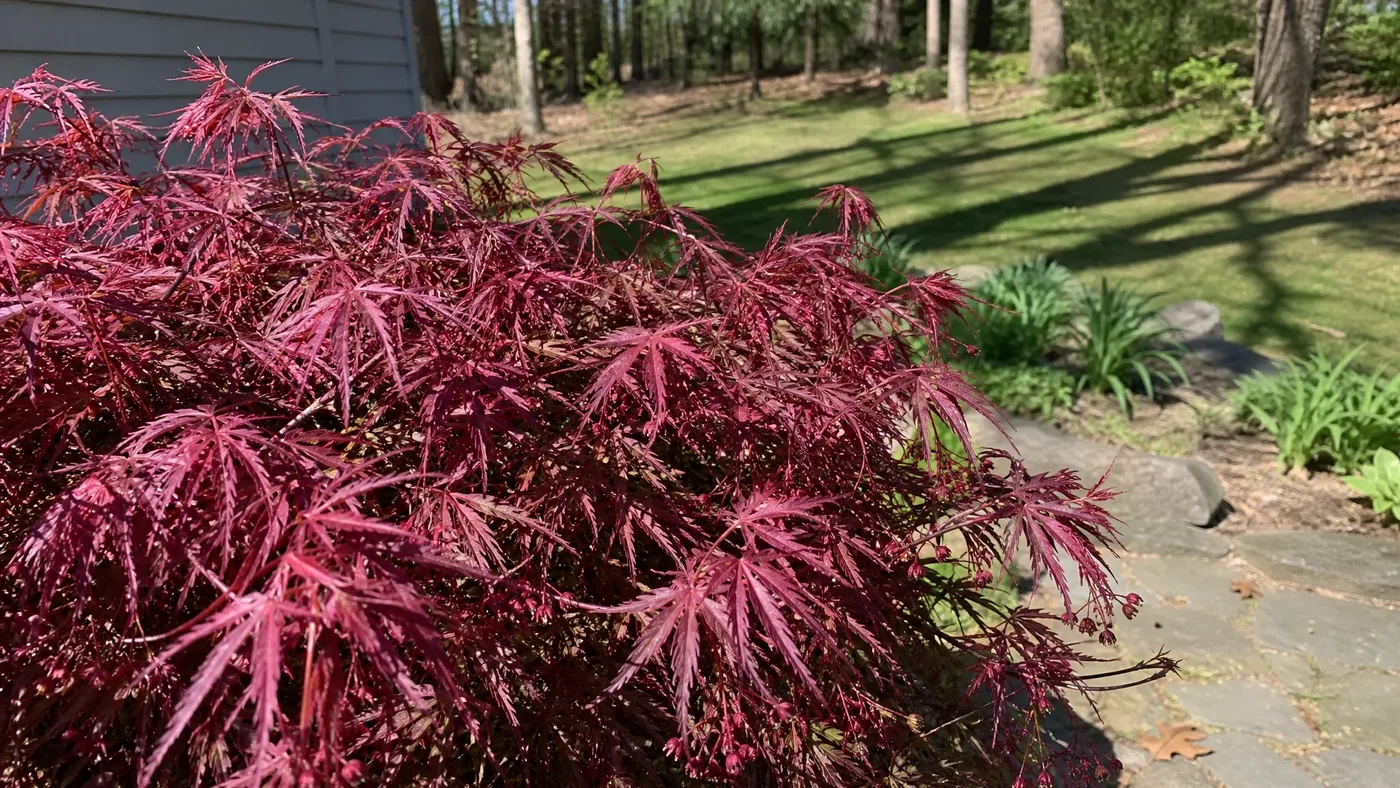
The Smallest Dwarf Japanese Maples: Ultra-Dwarf Types
Yatsubusa is a Japanese term for a plant form with tightly shortened growth, where the buds sit close together and the branches pack into a dense mound. In a Dwarf Japanese Maple, it is the trait that makes a tree truly small rather than merely slow. Get the distinction wrong and the plant pays for it. A tree that was never a real miniature stretches out of its pot and its space, while a true one kept in heavy, wet soil loses its fine twigs a few at a time.
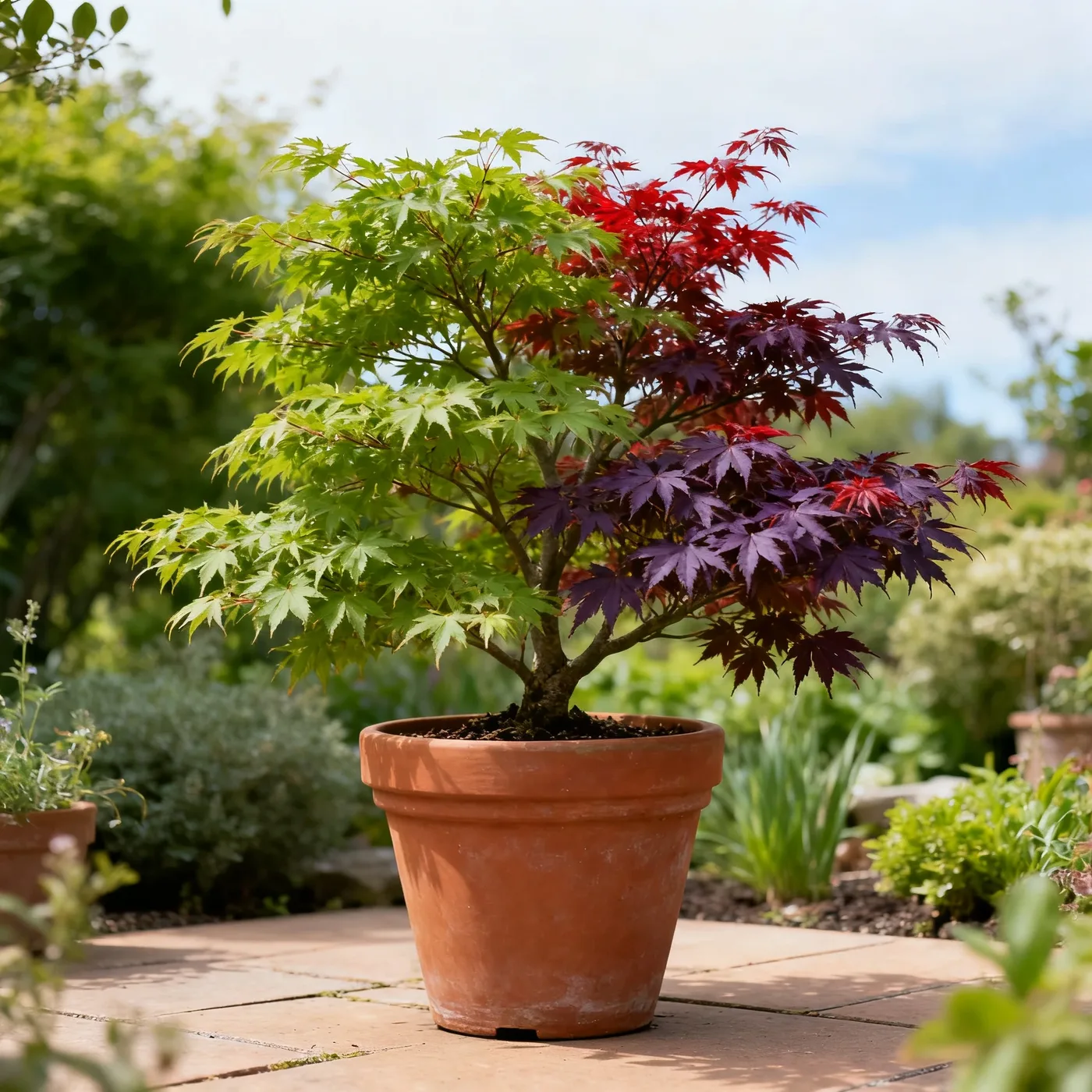
Below, you'll find out all about the smallest Dwarf Japanese Maple types, including how to read growth in inches per year, what the named cultivars really do, and which pots, light and tools suit a tree this size.
What Makes a Dwarf Japanese Maple Truly Miniature
Start with the word itself. On an ordinary maple shoot, the buds and leaf pairs are spaced along the stem like rungs on a long ladder. A yatsubusa form keeps the rungs close together, so each year's growth adds very little length but a good deal of side branching. The tree grows short and thick at once. That habit is inherited, which is why it belongs to named cultivars and not to any maple that happens to be slow.
Ultra-Dwarf Versus Merely Dwarf
We use "ultra-dwarf" for a cultivar that stays under about 5 feet at maturity. The line matters because the word dwarf gets stretched. UNH Extension describes Japanese maples as ranging from six to 25 feet tall, so a tree sold as a dwarf can still be a mid-size plant.
Why a Height Figure Alone Misleads
A number on a tag tells you where the story ends, not how it gets there. Two trees can both read "about 4 feet" and take very different routes. Ask for the height, the width and how many years the figure assumes. A narrow tree and a wide mound of the same height need very different places in the garden. Our guide to how big dwarf Japanese maples really get covers the wider dwarf range if you are still deciding between sizes.
In short, ultra-dwarf means under about 5 feet, and yatsubusa is how a tree gets there.
Reading Dwarf Japanese Maple Growth in Inches per Year
Nearly every dwarf gets called slow growing, and Japanese maples in general have that reputation. That phrase tells you almost nothing. A more useful habit is to divide the mature size by the years a source gives, which turns a vague promise into inches per year. The table below does that for the three sourced cultivars in this guide. The averages are our arithmetic from published sizes, not measurements of any one tree.
| Cultivar | Published size | Years to full size | Rough average |
|---|---|---|---|
| 'Kamagata' | About 4 feet tall | 5–10 | About 5–10 inches a year |
| 'Kiyohime' | About 6.5 feet tall and wide | 5–10 | About 8–16 inches a year |
| 'Sharp's Pygmy' | "Truly dwarf," no figure given | Not given | Ask the grower |
Read the wide range as honest. Because the source gives a span of 5–10 years, the yearly figure doubles from one end to the other, and a young tree in a good site tends toward the fast end. The ranking still teaches something. A cultivar that adds closer to a foot a year is not behaving like a true miniature, however small it looks in its first pot.
Measure Your Own Tree
Once leaves have dropped, find the ring of bud scale scars on a twig. It marks where a year's growth began, much like a ring in a trunk. Measure from that ring to the tip on the same branch each autumn and write the number down. After two or three seasons you have your own inches per year, which is far more reliable than any average, because your light, pot and watering shape it.
Profiles of Mikawa Yatsubusa, Kamagata and Koto Maru
These are the names that come up most often when people search for the smallest maple available. Only some have published figures we can verify, so we give numbers where a source supports them and say plainly where one does not. Availability matters here too. Which of these names we have in stock changes through the year, so ask before you plan around one.
'Kamagata'
'Kamagata' is a compact, shrubby tree growing to about 1.2 meters, roughly 4 feet, with a spread of only 0.5–1 meter, about 1.6–3.3 feet. That narrow footprint is its main gift. The lacy, light green leaves open edged in red and turn orange-yellow in autumn, and the tree wants a sheltered position and moisture-retentive, well-drained soil.
'Kiyohime'
'Kiyohime' is a vigorous, dense dwarf shrub reaching 2 meters in height and spread, which is about 6.5 feet. By our definition that is over the ultra-dwarf line, though it is still a compact mound. The leaves open pale green with orange-red edges and turn yellow-orange in autumn. Treat it as a small shrub, not a miniature.
'Sharp's Pygmy'
NC State Extension lists 'Sharp's Pygmy' as a slow growing, dense form and a truly dwarf maple with tiny leaves. It gives no height. That is typical of the smallest forms, which are often too slow to have been measured over a full lifetime.
Mikawa Yatsubusa, Koto Maru and Skeeter's Broom
Mikawa Yatsubusa carries the term in its name, which signals the compact, short-jointed habit this guide is about. Koto Maru and Skeeter's Broom belong to the same small-statured group, and the word "broom" in the second points to a dense, twiggy mass. We do not quote heights or yearly growth for these three, because we have no verified published figures, and you should be wary of any page that does without a source. Ask the grower how old the plant is and what size it was a few years ago.
Small Pots and Gritty Mix for a Dwarf Japanese Maple
A miniature maple has a miniature root system, and that changes what a good container looks like. Roots this small cannot pull water out of a deep, wet mass of soil, so the excess sits around them and the fine roots rot. The usual advice to give a tree room to grow runs the wrong way here. Choose a pot only one size up from the root ball, and make sure it has real drainage holes. Our guide to growing a dwarf Japanese maple in a pot covers the wider container routine.
What Goes in the Mix
Japanese maples grow best in well-drained, acidic soil that is high in organic matter. In a small pot those two aims pull against each other, so we split the work between materials:
- Coarse grit or pumice keeps air moving through the pot and lets water leave quickly after you irrigate.
- Pine bark or similar chunky organic matter holds some moisture and gives acidic, slow-breaking material.
- A small share of finer organic matter stops the mix from drying to dust in an afternoon.
Customers usually ask us whether plain bagged potting soil will do. For this size of tree it holds too much water and packs down within a season. The trade-off is that a gritty mix dries fast, and young maple leaves are not drought tolerant. So the mix works only if you check the pot often. Our watering guide is useful here.
Light and Shelter a Tiny Dwarf Japanese Maple Tolerates
With so few leaves, every one counts, and a scorched leaf takes a larger share of the whole canopy than it would on a big tree. The ideal spot has dappled shade, and NC State describes dappled sunlight as shade through the upper canopy all day. For a miniature we lean toward morning light and shade from the hottest afternoon hours. A larger dwarf like 'Crimson Queen' has more leaf to spare. Our guide to sun and shade needs goes deeper.
Wind and Dry Air
The species needs protection from drying winds, and 'Kamagata' wants a sheltered position. Wind strips water from thin leaf edges faster than a small root system can replace it, and the first sign is crisp brown margins. A pot on a hot deck or against pale pavement adds heat from below, so move miniatures to a wall corner, a bench with morning sun, or the lee of a larger plant.
Cold and Late Frost
The species is listed by UF/IFAS for USDA zones 5B through 8B, and UNH says it can perform well in zones 5 and 6 if planted in the right location. Young leaves are also sensitive to frost, and late frosts do damage. A tiny tree in a small pot has little soil to buffer cold, so in colder zones we keep containers in a sheltered spot and cover them when a frost follows early leaf-out.
Tools for Trimming a Dwarf Japanese Maple This Small
A miniature maple needs little pruning, and the cuts are tiny. Standard hand pruners are too coarse for twigs the thickness of a pencil lead. A pair of fine, pointed bypass snips or small bonsai-style scissors makes clean cuts without crushing the neighboring bud. Keep a small bottle of rubbing alcohol and a cloth nearby and wipe the blades between plants, because one dirty cut can carry trouble from tree to tree.
In our rows, most "pruning" on these trees is just removing a dead twig or one crossing branch.
When and How to Cut
UNH Extension recommends pruning in summer, after the spring growth flush, to avoid heavy sap flow. Work in this order:
- Look over the whole tree first and decide on two or three cuts at most.
- Remove dead or brittle twigs back to living wood.
- Take out one of any pair of crossing branches, choosing the one that points into the center.
- Cut just above a bud or side branch, so no stub is left to die back.
- Step back and stop. A yatsubusa form is already dense, and thinning too hard exposes inner leaves to sun.
Our guide to when and how to prune a dwarf Japanese maple adds more on timing for larger types.
Choosing Among Miniature Dwarf Japanese Maple Types
Pulling the profiles together, the decision comes down to three questions: how much room you have, whether you want a pot or a bed, and how rare a form you are willing to chase. The table below turns those into a first choice, and our comparison of dwarf cultivars helps if you want to see a wider range beside these.
| If you want... | Lean toward | Why |
|---|---|---|
| A narrow tree under about 5 feet | 'Kamagata' | About 4 feet tall and 0.5–1 meter wide, with lacy leaves |
| A dense mound and have room | 'Kiyohime' | About 6.5 feet tall and wide, so it needs space |
| The tiniest leaves and slowest pace | 'Sharp's Pygmy' | Described as truly dwarf with tiny leaves |
| A true yatsubusa collector's tree | Mikawa Yatsubusa, Koto Maru, Skeeter's Broom | Compact habit, but ask for age and size before buying |
If you are unsure, start with the cultivar that has published numbers. A plant you can plan around beats one you can only admire. Match the choice to the pot, too, since a miniature outgrowing its container in two seasons was not a miniature.
Small Maples Reward Slow, Steady Attention
An ultra-dwarf Dwarf Japanese Maple stays under about 5 feet because of its yatsubusa habit, not because someone called it small. Translate any size claim into inches per year, trust published numbers over adjectives, and remember that 'Kiyohime' and 'Crimson Queen' are compact but go past the line. Give the tree a small pot, a gritty mix, dappled shade, shelter from wind, and fine tools used sparingly.
Your next step is simple. At the nursery bench, pick up the tree you are considering and count the nodes along its last year's shoot. Close spacing tells you more than any tag.
Dwarf Japanese Maple
Nursery-grown Dwarf Japanese Maple in sizes from 2 Gallon, shipped to your door.
From $95.85
Shop Now →Dwarf Japanese Maple does best when it is raised with a light hand, so on our farms each one gets dappled shade, soil that stays evenly moist yet drains freely, and a spot out of the wind. Every plant we sell is grown on our own farms, and we put top-quality trees and shrubs into that work. If an ultra-dwarf from this guide has caught your eye, browse what is in stock now and see which one fits your space.