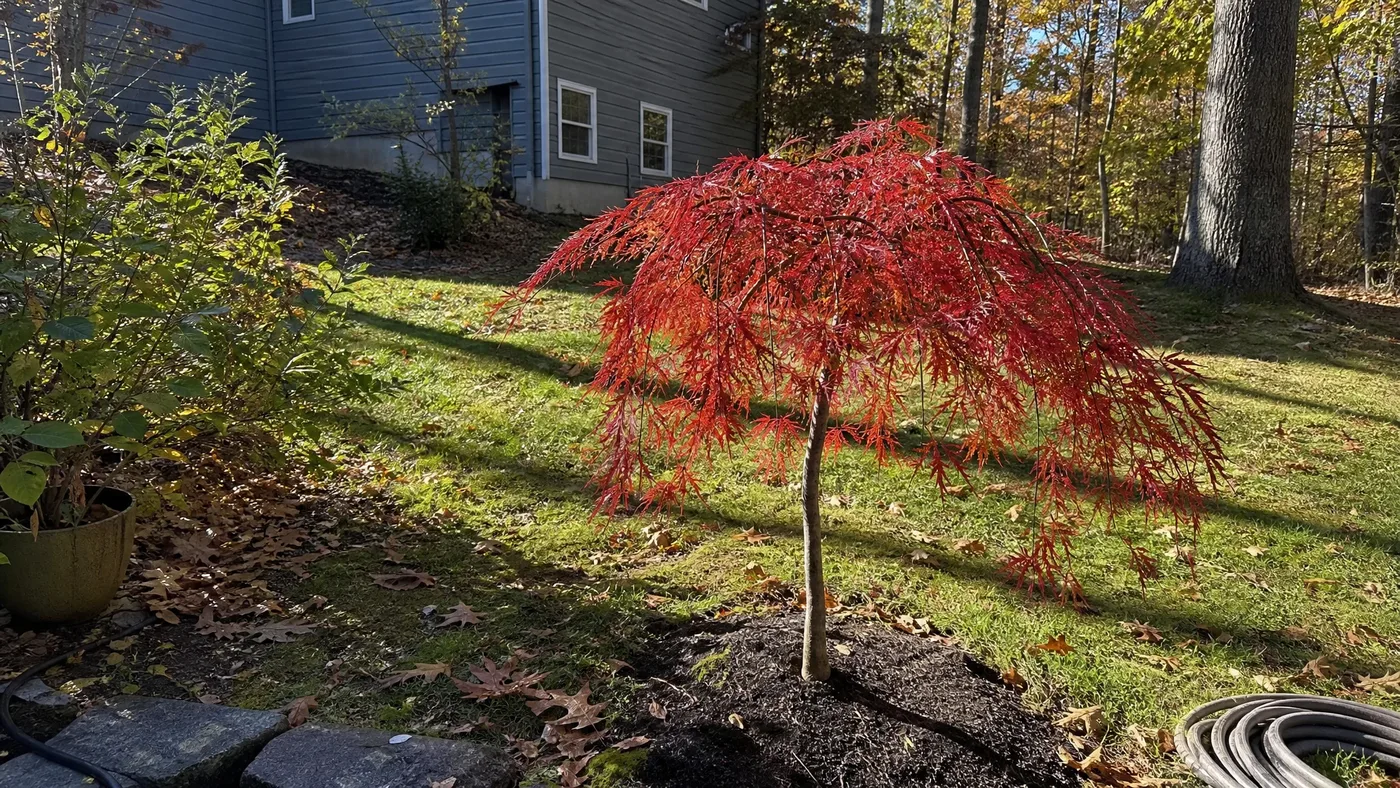
Dwarf Japanese Maple Standard Trees: Lollipop and Umbrella Forms
Walking our rows in late afternoon this season, we kept stopping at the same sight: a round, leafy canopy floating on a bare trunk, lit from behind so every leaf glowed. Customers usually ask us the same thing when they see one. Is that a real tree, or two plants stuck together?
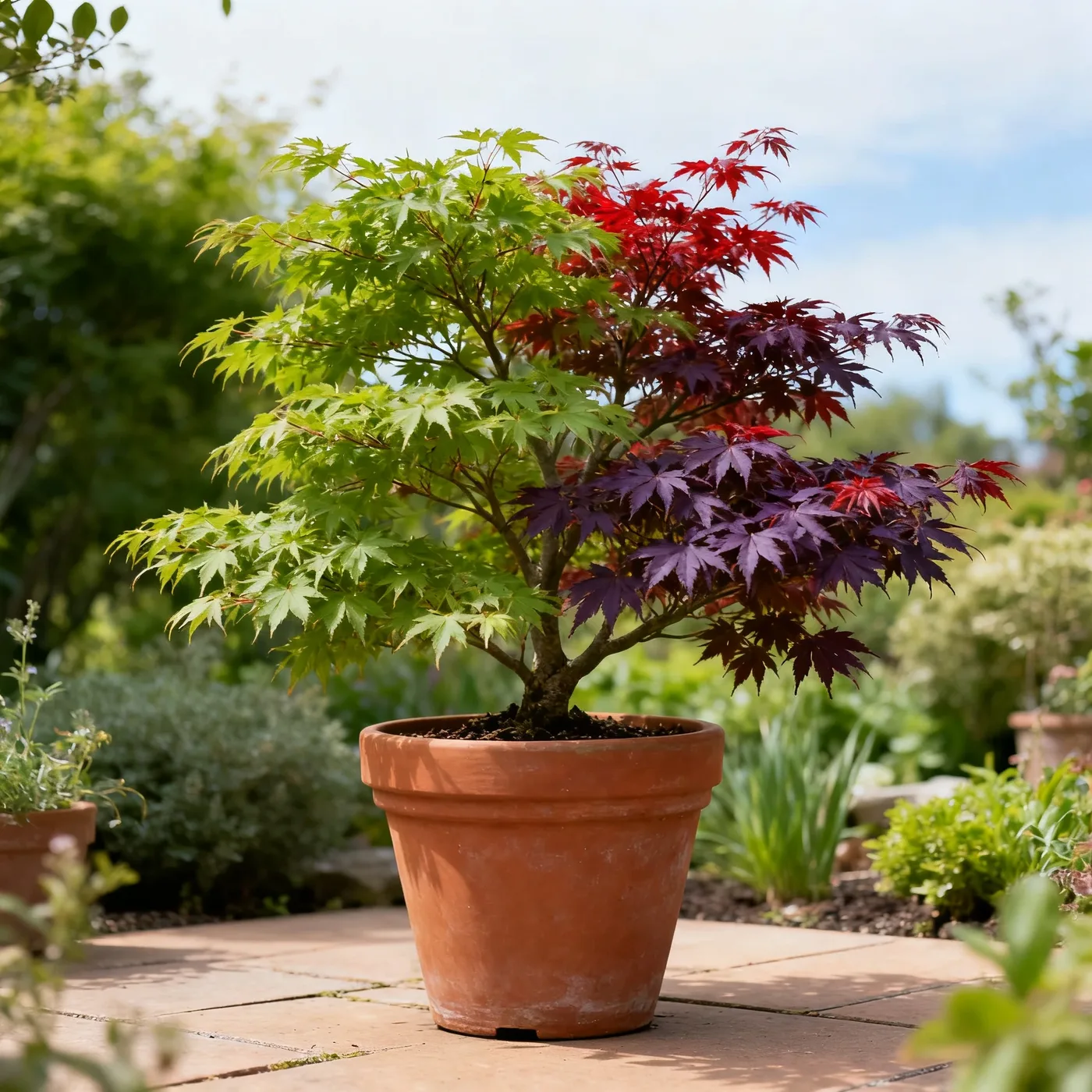
It is two plants, joined on purpose. A compact dwarf cultivar is grafted to the top of a straight trunk and left to build a head, and that is the lollipop or umbrella tree you see on tags. Done well, you get a small tree with room beneath it for underplanting. Done badly, with a weak union or one hard prune, the shape is gone for good.
We'll walk you through where the form came from and how it is made, then how to read the tags and choose a cultivar, and finally how to inspect a tree before you buy and keep its crown in shape.
Where the Lollipop Tree Came From
The name is a nursery nickname, but the idea behind it is much older. Growers have long joined a chosen crown to a separate, clear stem, a practice called topworking, and a tree grown that way is called a standard because its trunk stands bare below the head. Roses and fruit trees were shaped like this long before anyone put a dwarf maple on a stem.
We can't point to one inventor of the maple version, and we would rather say so than invent a story. What we can describe is the raw material. Acer palmatum is native to southeast Korea and central and south Japan.
Selection there and since has given us small-leaved, slow, densely branched forms that stay compact for decades. Lifted onto a trunk, such a plant shows its leaf color against the sky instead of at your ankles, and you can walk and sit beneath it. "Lollipop" came from the silhouette, "umbrella" from a head that spills down toward the ground.
What the History Means Today
For you, the history comes down to one point. This is a made shape, not a natural habit. It depends on a cultivar that stays compact and a union that stays sound, and nearly everything later in this guide follows from that.
Why Nurseries Graft a Dwarf Japanese Maple Onto a Trunk
A standard is two plants living as one. The trunk and roots belong to a rootstock chosen for vigor and a straight stem. The head belongs to the dwarf cultivar, joined at the top of the trunk, usually 2–4 feet above the soil.
Commercial nurseries graft maples because the technique takes real practice. A standard adds a second skilled step, since the trunk has to be grown straight and clear before the cultivar goes on.
What the Trunk Does
The trunk has one job, which is to hold the head at a useful height while feeding it through the union. It is not the cultivar you paid for, and it will never look like the canopy. Any shoot that appears on the trunk below the union comes from the rootstock, and it should come off at the base as soon as you see it, because it will compete with the head for energy.
What the Canopy Does
The canopy is the cultivar, and it grows as that cultivar would, only raised. A slow, mounding plant fills out into a ball over the years, while one that arches and cascades drapes over its trunk like an umbrella. Because the head sits on a stem, every branch shows from every side, so tidy structure matters far more here than on a shrub-form maple.
The union itself shows as a slight swelling or a faint seam at the top of the trunk. It is the one spot on the tree that needs your attention for life. Keep it above the soil, keep the bark around it unwounded, and leave it alone when you prune.
Lollipop, Umbrella and Standard Mean Different Shapes
Tags on these trees are not standardized, and one nursery's "umbrella" is another's "lollipop". The terms below are how we use them, and they are the questions worth asking wherever you shop.
| Tag term | What it describes | What produces it |
|---|---|---|
| Standard | Any tree with a bare trunk topped by a head | Grafting a cultivar onto a clear stem |
| Lollipop | A rounded, ball-shaped head | A compact, multi-branched, mounding cultivar |
| Umbrella | A domed head whose outer branches arch down | A cascading or arching cultivar |
| Topworked | The method, not the shape | The head grafted at the top of the trunk |
The practical difference between the first two shapes and the third is how they age. A ball holds its outline with light pruning, because the cultivar grows slowly and in every direction. An umbrella is shaped by gravity, so its lowest branches keep lengthening toward the ground, and over time you will need to decide how far down you want the skirt to hang.
Trunk height is the other variable that tags often leave out. A head at 2 feet sits low enough to rest beside a path or inside a pot. At 4 feet it reaches eye level in a border. Ask for the measurement from soil to union, and ask how the head looked a year ago, because a slow cultivar grows only a modest amount each season.
Cultivars That Make a Good Dwarf Japanese Maple Canopy
The ball form only works with compact, slow, many-branched cultivars. The one we point most customers toward is 'Mikawa Yatsubusa', a compact, multi-branched small tree growing slowly to about 3–4 feet.
That multi-branched habit is what a lollipop needs, because it fills a head without leaving gaps. Leaf color is best in partial shade, and full sun is tolerated only if the soil stays reliably moist.
Other Cultivars We Would Choose
'Shaina' is dense and compact with red foliage, and it gives a ball a deep, solid color. 'Sharp's Pygmy' is a slow-growing, truly dwarf maple with tiny leaves, and it suits a tight, fine-textured head.
'Crimson Queen' has lacy, dissected purple foliage that turns scarlet in fall, and it suits the umbrella shape better than the ball. Go in knowing that it reaches a height and spread of 5–8 feet, so its head will want pruning to stay modest. Our cultivar comparison goes further on each.
What Does Not Work
Upright or full-size Japanese maples cannot be trained into this form. Their strongest growth goes up and out, and the species alone reaches 10 to 20 feet by UF/IFAS and up to 25 feet by NC State. Clip one into a ball and you fight it every season, and the inside goes bare.
If a seller offers a lollipop from a vigorous cultivar at a bargain, treat it with suspicion, and read how dwarf and full-size maples differ before you commit.
Judging the Graft Union and Trunk Before Buying
Most of what decides whether a standard becomes a good tree is visible in about two minutes, if you know where to look. Start at the union, then run your eye down the trunk, then step back for the canopy. One question we get constantly is whether a bent trunk will straighten with time. Mostly it won't, so choose a straight one.
- The union should be smooth and fully healed, with bark that meets evenly on both sides. Avoid any gap, crack, sunken ring or weeping wound.
- The trunk should be straight and the same thickness from base to union. A sharp kink or a stake tie cut into the bark is a lasting scar.
- The base of the trunk should be clean. Any shoots below the union mean the tree has not been kept tidy.
- The canopy should be balanced around the trunk, with leaves in every direction and no bare side. A lopsided head stays lopsided.
- The leaf edges should be clean. Crisp, brown margins point to scorch, which is one of the troubles that also include anthracnose and frost damage.
Then look at how the tree will be planted. Japanese maples like shallow roots, so keep no more than about 1 inch of soil over the main roots. That rule matters more here than anywhere, because burying a standard to steady it can bury or rot the union.
Keep the union well above the soil line, and follow the steps in our planting guide.
Staking, Pruning and Light for a Dwarf Japanese Maple Crown
A head on a stem acts like a sail, and it sits higher than a shrub-form maple, so it meets more wind and more light. The care that keeps it good is mostly support, a very light hand and the right place in the garden.
Support the Trunk Without Strangling It
Use a sturdy stake on the windward side and tie the trunk with a wide, soft band, loose enough to move a little. Check the tie every season, because a trunk that thickens inside a tight tie ends up with a ring.
Some advice says to plant deeper so the tree stands firmly without help. Don't, since the union has to stay in the air. Leave the stake until the trunk holds the head without leaning.
Prune the Head, Never the Union
Japanese maples are best pruned from July to January, because they bleed sap from cuts at other times. Summer, after the spring flush, also works well. July falls within both windows.
Take out dead twigs, crossing branches and any shoot that breaks the outline, and take a little each year instead of a lot at once. For methods, see when and how to prune. Never cut below the head into bare trunk.
How Light Falls Through the Crown
Dappled shade is ideal. For a standard, that means morning light and shade from the hottest afternoon sun. In spring, young leaves are frost-sensitive and not drought tolerant, so water the root zone steadily as the head leafs out.
Summer sun is when the outer leaves scorch first, because the canopy has nothing to shade it. In fall, the same open crown lets low light shine through the color. Our sun and shade guide covers placement in more detail. In a pot, turn the tree a quarter turn every few weeks so the head grows evenly.
A Dwarf Japanese Maple Standard Worth Paying For
This form earns its cost for people with small spaces and a good eye: an entry with a pair of trees, a bed where the canopy is lifted so ferns or low perennials can grow beneath, or a large pot on a terrace. It gives less to someone who wants a quick, big tree. Japanese maples are slow-growing and expensive, and a standard costs more again, since it takes years of trunk growing and a skilled graft.
Expect a young head to look modest on arrival, because you are buying structure and the shape comes with time. Choose a compact cultivar, a straight trunk and a sound union, keep the union above the soil, and trim lightly. In October, with the leaves turned, the head throws a round, lace-edged shadow of scarlet and gold onto the ground below, and it drifts across the grass as the afternoon light lowers.
Dwarf Japanese Maple
Nursery-grown Dwarf Japanese Maple in sizes from 2 Gallon, shipped to your door.
From $95.85
Shop Now →Dappled shade, acidic and well-drained soil, and even moisture are what each Dwarf Japanese Maple gets on our farms, the same setup a standard will want at home. Our own growers raise and pack these top-quality trees. For a lollipop or umbrella form of your own, pick out a plant for your garden.