Best Dwarf Japanese Maples for Full Sun and Hot Afternoons
"The tag says full sun tolerant. Will it still look good after a hot afternoon?" A customer asked us exactly that, and our answer was a careful "not always." The phrase on a plant tag describes survival in a bad week, not leaves that stay clean from June to September.
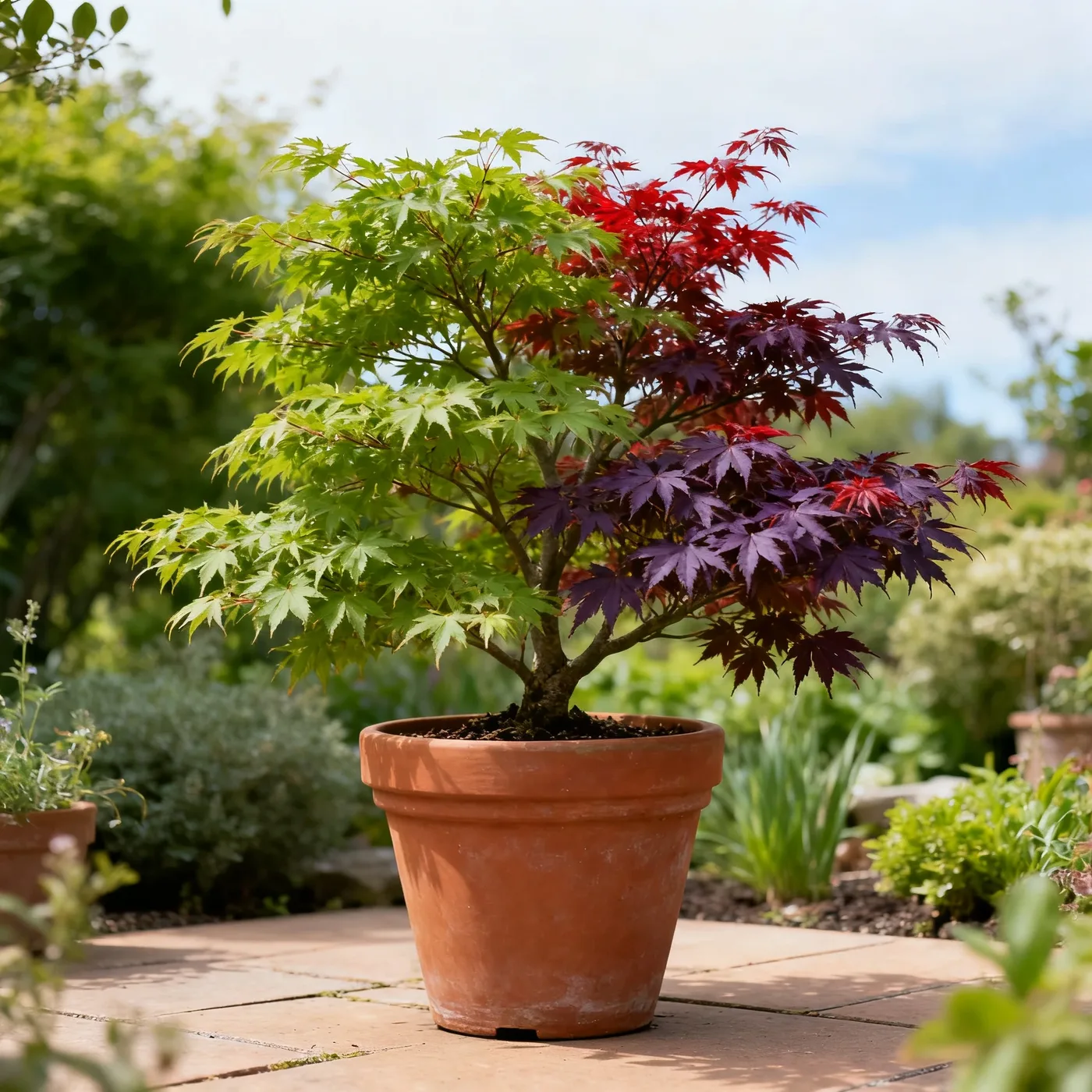
A dwarf Japanese maple is also a small plant on a small root system, which changes how sun affects it. Done badly, sun means crisped leaf margins and a tree that looks tired by August. Done well, it means deep color and dense growth.
This guide covers everything you need to know about choosing and placing dwarf maples in strong light, from leaf type and cultivar ranking to afternoon exposure, root ball size and watering.
Laceleaf Dwarf Japanese Maples Against Upright Cultivars
The single best predictor of sun trouble is the leaf. A finely cut laceleaf has thin, narrow lobes with little tissue to buffer heat, so the edges dry before the rest of the leaf can respond. A sturdier upright dwarf with broader lobes loses water more slowly.
That is the whole ranking in one idea. The two groups look different in a pot at the shop and behave differently on a south-facing wall.
The Laceleaf Group
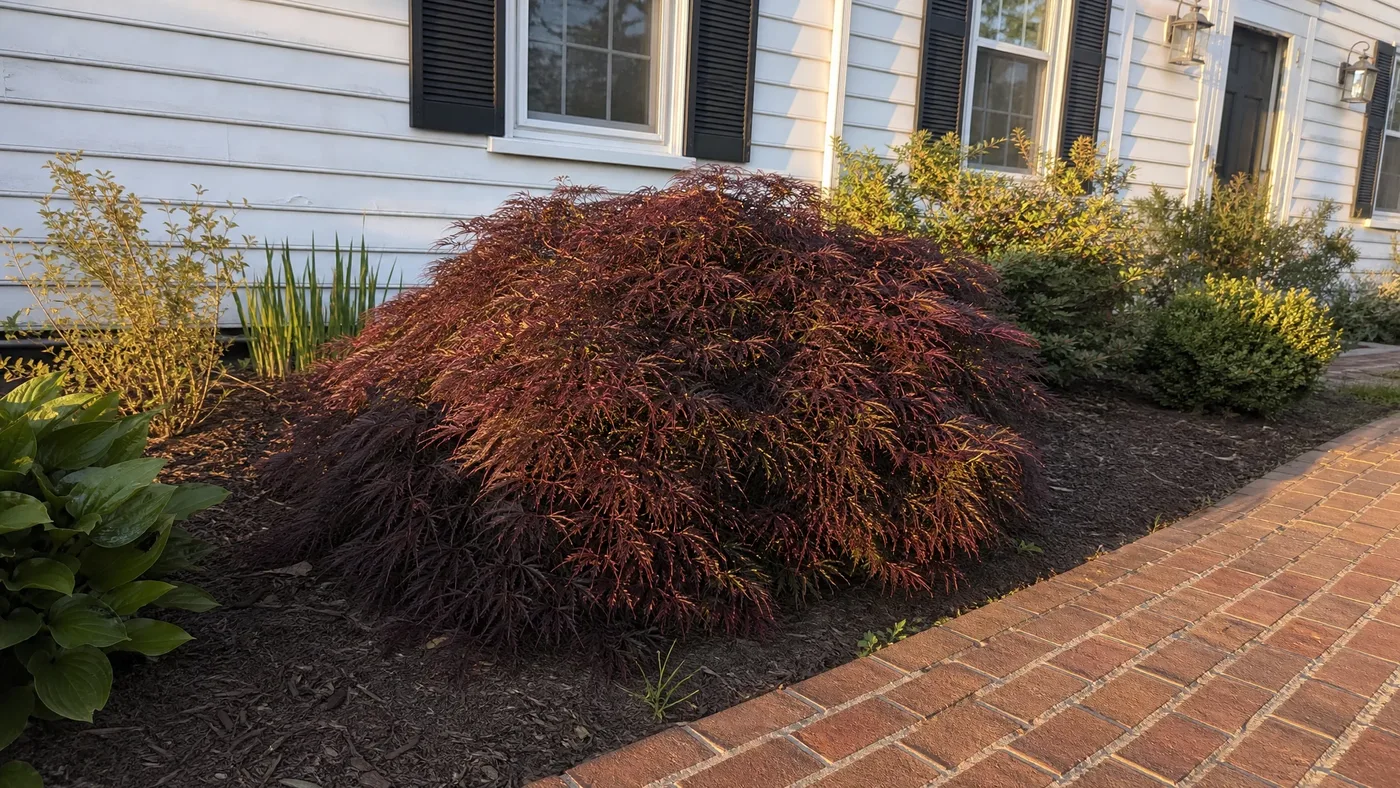
'Crimson Queen' and 'Tamukeyama' are the laceleaf dwarfs most people ask about. 'Crimson Queen' is a dwarf tree with dissected, lacy purple foliage that turns bright scarlet in fall. That lace is also the weakness. In our rows, the laceleaf maples show brown tips first, usually on the side facing west.
The Sturdier Upright Group
'Shaina' is described as dense and compact with red foliage, and that dense habit means the outer leaves shade the inner ones. 'Bloodgood' has broader burgundy leaves. Neither is immune to scorch, but both give you more margin before the damage starts.
The table below is our ranking from most to least sun margin. It reflects what we see, not a laboratory test.
| Cultivar | Leaf type | Our sun verdict |
|---|---|---|
| 'Shaina' | Dense, compact, red | Best margin. Handles strong sun if the roots stay moist. |
| 'Bloodgood' | Broader, burgundy | Good margin. Check its mature size before you plant it as a dwarf. |
| 'Crimson Queen' | Lacy, dissected | Morning sun only in warm regions. |
| 'Tamukeyama' | Lacy, dissected | First to scorch. Give it afternoon shade. |
| 'Sharp's Pygmy' | Tiny leaves, truly dwarf | Not ranked. The sources we use say nothing about its sun tolerance. |
If you want the wider comparison of form and size, our cultivar comparison covers the rest.
What Nursery Tags Claim and What Scorched Leaves Show
Tags are written for the whole species, and the species is a sprawling one. Heights range from six to 25 feet, and the same extension source says the ideal spot is one with dappled shade. A tag that says "full sun" is either averaging cultivars or giving the best case.
Tags and sources can disagree, and that is useful. The species prefers dappled sunlight, meaning shade through an upper canopy all day, while a tag may say full sun. Both can be true. They describe different climates and different expectations of how the leaves should look.
Now the leaves. Scorch is not a mystery once you know the pattern, and it differs from other problems:
- Scorch shows first on the outer, sun-facing leaves, with dry brown margins that spread inward while the veins stay green longer.
- Damage on the inner, shaded leaves with the outer leaves fine points to something else, such as disease or frost, not sun.
- Tips that crisp after a hot, dry, windy stretch with moist soil underneath suggest wind as much as sun.
- Damage that appears on the same side of the tree each year tells you the site is the cause, not the plant.
The species can also suffer leaf scorch, and young leaves are not drought tolerant. Spring growth is the tender stuff. A tag cannot promise it will survive a heat spike in May.
Our position is plain. Treat "full sun tolerant" as a claim to test on your own site, not a fact about the cultivar. Our guide to sun and shade needs covers the general rules, and this guide covers what the tag leaves out.
A Dwarf Japanese Maple in Morning Sun or Afternoon Glare
Hours of sun matter less than which hours. Morning light is cooler and the leaves are still full of water from the night. Afternoon light arrives when the air is hottest, the soil has dried, and the leaves are asking the most of the roots.
Because of this, a spot with several hours of east light is far kinder than a spot with a shorter stretch of west light. We tell customers to look at the planting spot at mid-afternoon on a sunny day, not at breakfast. If the sun is still on the spot then, assume it is a hot site.
Where Morning Sun Works
East and northeast exposures suit nearly every dwarf cultivar, laceleaf included. The tree gets enough light to color well, and the heat of the day passes over it. This is where 'Tamukeyama' and 'Crimson Queen' do best.
Where Afternoon Sun Costs You
West and southwest exposures are the hard ones. Reflected heat from a wall, a driveway or gravel adds to the load, and a dwarf that sits close to that surface gets it at leaf height. If you must use such a spot, choose 'Shaina' and shade the roots, not only the canopy.
Dappled shade from a taller tree is the best of all, because it softens the afternoon without blocking the light. A light canopy of high branches does more for a dwarf maple than a fence does, since a fence can still bounce heat back.
The same logic holds in a container, where the pot itself absorbs heat, so a pot on a sunny patio is a hotter site than the same tree in the ground.
Why a Dwarf Japanese Maple Dries Faster Than Its Size Suggests
People assume a small tree needs little water. The opposite is closer to true in sun. A dwarf's root ball is small and shallow, so it holds a small reserve, while the canopy above it is losing water in strong light.
The result is a short gap between "fine" and "stressed." A larger tree has deep roots and a big reservoir. A dwarf can move from moist to dry in a day or two of hot weather, especially in the first few years while the roots are still filling the planting hole.
UF/IFAS rates the species' drought tolerance as moderate, and young leaves are not drought tolerant. Put those together and you get our rule: a sunny dwarf should never be allowed to dry out completely.
How to Read the Soil
Push a finger down beside the root ball, not at the surface. The top inch dries first and says little. If it is damp below, wait. If it is dry at finger depth, water slowly and deeply. We cover timing in detail in our watering guide.
Why Soil Matters More in Sun
The sources agree on evenly moist, well-drained soil that is high in organic matter. In sun, that balance is harder to hold. Sandy soil drains so fast that the root ball dries between waterings, while heavy clay holds water around roots that cannot use it. Amend the planting area for the long term rather than relying on frequent watering.
Northern Light and Southern Heat for a Dwarf Japanese Maple
Climate changes what "full sun" means. The species is hardy in zones 5a through 8b according to NC State, and UF/IFAS gives 5B through 8B. UNH Extension adds that Japanese maples can perform well in zones 5 and 6 if planted in the right location. The range is wide, and the sun rules change across it.
In the cooler north, sunlight is weaker and the summer is shorter. Even a laceleaf can often take a good deal of sun there, as long as it has shelter from wind. Wind does as much damage as light in open northern sites, and the tree does best when protected from drying winds.
In the hot south, our advice flips. Any laceleaf wants morning sun and afternoon shade, with no exception for a "full sun" tag. Even 'Shaina' benefits from some relief. Sources stop at zone 8b, so we do not suggest warmer zones. If you are at the edge of the range, ask your local extension service about heat in your area.
Our guide to hardiness zones for dwarf Japanese maples covers cold and heat limits in more depth. The rule of thumb is simple:
- Cooler regions: morning sun is the minimum, and more is possible for the sturdier cultivars if the soil stays moist and wind is blocked.
- Mid-range regions: full morning sun, then shade from early afternoon on.
- Hot regions: bright shade or dappled light all day for laceleaf, morning sun only for the upright types.
Morning Water and Mulch, Not Afternoon Rescue Watering
One of the most common questions we get is whether to soak a wilting maple at midday. Our answer is to do it only if the soil is truly dry, and to see it as a repair, not a routine.
Watering in the morning lets the roots fill before the heat starts. The leaves go into the afternoon with a full supply, and any water on the foliage dries quickly. A steady morning schedule is far more effective than emergency watering after the leaves have already drooped.
Why Midday Rescue Watering Fails
By the time the leaves curl, the damaged tissue will not recover. Water at that point saves the tree but not the leaf margins. Curling can also be a way for the leaf to cut its exposure, so a drooping leaf at 3 p.m. in damp soil does not need more water. Check below the surface first.
What Mulch Does
A layer of organic mulch keeps the root zone cooler and slows evaporation, which matters most for a shallow dwarf root ball. Keep it a little back from the trunk. Refresh it as it breaks down. In a sunny site, mulch is as important as the watering itself.
For site soil, our guide to soil for a dwarf Japanese maple shows what to mix in so the mulch has something to protect.
Which Dwarf Japanese Maple Earns a Sunny Spot
Here is the verdict, ranked by the evidence we have and what we see in our own rows.
First is 'Shaina'. Its dense, compact habit gives it the most margin, though it still needs steady moisture. Second is 'Bloodgood', which is also good in strong light, once you have confirmed its size suits your space. Third is 'Crimson Queen', which we place in morning sun only. Last is 'Tamukeyama', which we would never put in afternoon glare.
We cannot rank 'Sharp's Pygmy' for sun. It is described as a slow-growing, truly dwarf maple with tiny leaves, but the sources say nothing on light.
How to Test a Spot Before You Commit
Treat the first summer as the trial. Watch the sun-facing side of the tree on the first hot, dry week and note whether the margins stay green. If the outer leaves brown while the soil is moist, the site is too bright for that cultivar, and moving it to shade is better than hoping it hardens off.
Judge by the second year, not the first. A newly planted dwarf has a small root system, so early scorch often reflects water supply more than sun. If a tree is clean through its second hot summer with steady morning watering and mulch, you have found a spot it can keep.
A Dwarf Japanese Maple in Sun: What Held Up
The claim that held up best is that upright, denser cultivars take more sun than laceleaf forms. The claim that held up in part is the tag itself: "full sun tolerant" can be true in a cool climate with steady water, and it is not true for a laceleaf on a hot west wall. We would not treat any of them as sun-proof.
The claim we would drop is that a small tree needs little water. In sun, it needs it more often. Be hedged about all of this: your own site, wind and soil will decide more than a tag will.
Dwarf Japanese Maple
Nursery-grown Dwarf Japanese Maple in sizes from 2 Gallon, shipped to your door.
From $95.85
Shop Now →Dwarf Japanese Maple settles in best on our farms when it gets dappled light, soil that holds an even moisture yet drains freely, and a spot where the leaves stay clean. Every plant we sell is a top-quality tree raised on our own farms, so if you are picking a maple for a bright, warm corner, begin with one from our shop.