Dwarf Japanese Maples With Green or Yellow Leaves
One spring we drove past a neighbor's border where every maple glowed the same hot red, a wall of burgundy against a gray fence. What stayed with us afterward was how badly we wanted one of them to be green. Plenty of people carry the same wish, and they usually type it as a search for a dwarf Japanese maple with green or yellow leaves.
The wish goes wrong in a predictable way. A buyer picks up a gold-leaved tree sold under a small-sounding name, plants it in a bright corner, and within a few seasons the tree has outgrown its spot while its pale leaves crisp at the edges every hot afternoon.
Below, you'll find out all about green and yellow dwarf Japanese maples, including which cultivars really stay small, how many plants a twenty-foot border takes, and where yellow-leaved ones burn.
A Twenty-Foot Border and a Wish for Chartreuse
Our example is a border twenty feet long that runs beside a drive, with the house wall rising behind it on the west side. That placement matters more than almost anything else we will say, because it gives the bed morning sun and shade from early afternoon on. The goal is simple: green and chartreuse leaves from spring to fall, with nothing tall enough to hide the windows.
We set a ceiling of about 6 feet and hold to it for a reason. The species is sold in sizes from six to 25 feet tall, so the word dwarf only helps if the cultivar behind the name really stays small. A plant that outgrows a drive-side bed gets cut back every year, which ruins the shape you bought it for.
Chartreuse, for anyone who has not met the word on a plant tag, is the yellow-green of a new leaf just opening, and it is the color we wanted most. Green alone would have been easy to buy. Chartreuse on a plant that stays small and survives a hot afternoon is what narrows the field.
The red-leaved cultivars are well covered in our comparison of red, coral-bark and variegated dwarf maples, so this guide takes the other road. Everything that follows is the real sequence of decisions for one border, starting with the plants we ruled out.
Why Most Golden Dwarf Japanese Maple Selections Fall Short
Search for a yellow dwarf Japanese maple and the names that come up first are 'Orange Dream' and 'Summer Gold'. Both are lovely, and neither is a dwarf in the sense this border needs. 'Orange Dream' is a bushy shrub reaching 3 meters, about 10 feet, with yellow spring leaves that turn greenish in summer and orange-yellow in autumn.
'Summer Gold' is smaller, but its ultimate height and spread are 2 meters, roughly 6.5 feet, and it is an upright tree with a rounded crown. That is a little over our ceiling, and spread counts as much as height in a bed only a few feet deep. Customers usually ask us for 'Orange Dream' by name, and we understand why, since it is the gold maple everyone has seen.
The pattern is worth knowing because it repeats across the trade. Gold-leaved maples sold as small often turn out to be full shrubs or small trees, and a label saying compact tells you nothing about size after twenty years. Here is how our first cut came out.
| Cultivar | Size from the sources | Border verdict |
|---|---|---|
| 'Orange Dream' | About 10 feet | Out, far too large |
| 'Summer Gold' | About 6.5 feet tall and wide | Out, over the ceiling |
| 'Mikawa yatsubusa' | 4–6 feet tall, about 4 feet wide | In |
The cut is no judgment on either gold maple, only on fit. Ten feet of 'Orange Dream' would swallow a bed four feet deep, and a row of 'Summer Gold' would need steady pruning just to stay inside it.
Green Dwarf Japanese Maple Choices That Stay Small
That left the green-leaved cultivars, and one name carried the whole border. A second name deserves a mention, and a few search terms deserve a straight answer.
Mikawa Yatsubusa as the Anchor
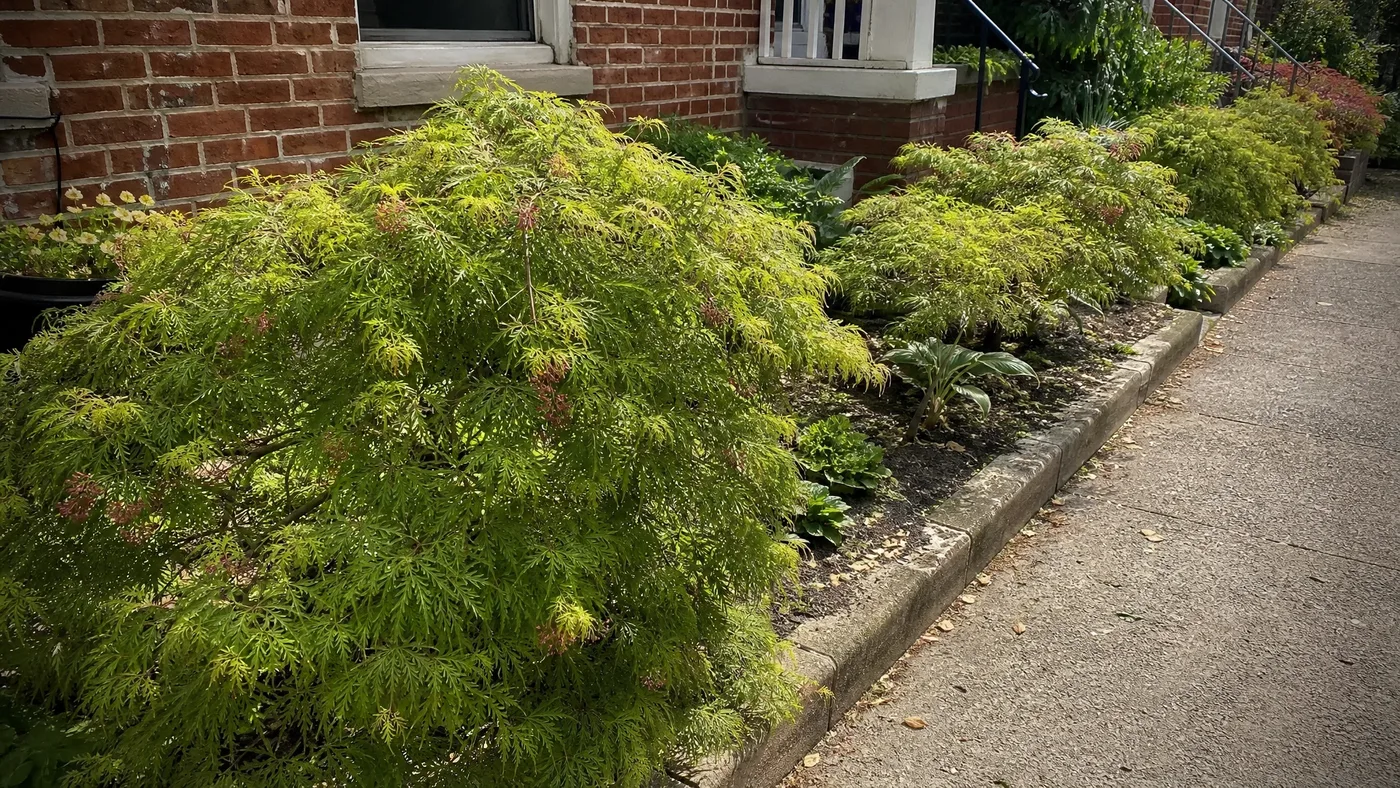
This slow-growing tree will grow to 4–6 feet tall and 4 feet wide with a multi-branched, dense form. Its leaves open yellow-green in spring, turn medium green in summer and finish yellow-gold in fall, with the serrated edges of the outer leaves a bright red. That is chartreuse at the start of the year, green through the heat, and yellow at the end, all on one plant.
The same cultivar is also described as a dwarf growing slowly to about 1–1.2 meters, roughly 3–4 feet. The figures do not agree, and we will not pretend they do. We plan for the larger figure, because spacing for the bigger number costs nothing if the plant stays smaller.
What Viridis, Katsura and Willow Names Mean
Several of the searches that bring people here use names rather than cultivars. Viridis is Latin for green, so it turns up on green-leaved selections, and it says nothing about size. Katsura and willow names point to leaf color or leaf shape, and neither one guarantees a small plant.
We give no height for those names because none of our sources does. Ask for the mature size of the exact cultivar, and treat anything above about 6 feet as a different tree. We also left 'Sharp's Pygmy' off the list. It is a truly dwarf maple with tiny leaves, which is wonderful at a doorstep but reads as texture, not a sweep of color, from a driveway.
Counting Plants and Spacing Along the Border
The arithmetic is short. A 'Mikawa yatsubusa' is about 4 feet wide at maturity and the bed is 20 feet long, so five plants set 4 feet apart on center fill it exactly. The two end plants sit 2 feet from the ends of the bed, half a plant width, so the row does not look cut off.
The same half-width rule sets the distance from the house wall and from the edge of the drive, 2 feet each. That makes the bed at least 4 feet deep, which is why we measured depth before we counted plants. A tree pressed against a wall grows lopsided as it reaches for light, and leaves nearest the pavement take the most heat.
Why We Did Not Plant Closer
Spacing at mature width leaves the border sparse for years, and customers often ask us whether to plant closer. We say no. Crowded maples lose their lower branches and the layered shape that makes them worth owning, and moving one later is harder than waiting. Fill the gaps with a low groundcover or mulch instead.
Budget Without Prices
We will not quote prices, because they swing with container size and from one nursery to the next. Japanese maples are both slow-growing and expensive to buy, so five plants is a real purchase. Our buying guide applies here: choose the best container you can afford for the plant nearest the door, and let the others catch up.
Where a Yellow-Leaved Dwarf Japanese Maple Burns
The yellow-green flush is the stage of this plant that needs the most care. The young leaves of the species are sensitive to frost and not drought tolerant, and leaf scorch is one of the problems that can occur. Spring is when 'Mikawa yatsubusa' wears its pale flush, so the plant looks best exactly when its leaves are least prepared.
We often see that flush go crisp at the edges after one hot, windy afternoon, while darker leaves beside it look untouched. The tree survives, but the brown rims stay on the leaf all season. Placement is how you prevent it.
Reading the Border's Light
The west wall gives this bed shade from early afternoon, which is the best protection in the whole plan. UNH Extension says ideal placement is dappled shade, and NC State lists the same for the species. The open south end, where the drive widens, gets the extra hours of sun, so that plant gets deeper mulch and a piece of shade cloth in hot spells. Our sun and shade guide covers the light in more detail.
Wind, Water and Late Frost
The tree also needs protection from drying winds, and a drive is a natural channel for them. If a gold-leaved cultivar like 'Summer Gold' is on your own list, give it the most sheltered, shadiest spot you have, not the open end. When a late frost is forecast after the leaves have opened, we cover young plants with a sheet overnight.
The Planting Weekend and the First Summer
Planting weekend started on a Saturday morning with no digging at all. We set the five pots out on their 4-foot centers, walked to the street and looked back, because moving a pot costs nothing and moving a planted maple costs a season. Our own trees come from our farms already rooted in their containers, so the weekend is mostly digging and watering.
The soil in this bed was ordinary builder's fill. Maples grow best in well-drained, acidic soil high in organic matter, so we worked compost into the planting area and skipped any lime. Our planting guide has the full method, and this is the short version for the border.
- Check the layout from the street before any digging, with each pot 2 feet from the wall and the drive edge.
- Dig each hole wide and only as deep as the root ball, so the top of the ball sits level with the surrounding soil.
- Loosen any circling roots, set the tree, and backfill with the native soil mixed with compost.
- Water slowly until the soil is soaked through, then mulch, keeping the mulch back from the trunk.
- Hang shade cloth on the south-end plant for the first hot spells.
The first summer was a watering exercise. The tree does best in evenly moist soil, so we checked the south-end plant every few days and gave it a slow soak when the top inch of soil felt dry. When a leaf rim started to brown, we looked at the soil before we blamed the sky, because dry roots cause scorch as often as sun does.
Year Five of the Dwarf Japanese Maple Border
By the fifth summer the five trees were nowhere near the 4-foot width we had spaced for, which is what you expect from a slow-growing plant. Each had thickened into the dense, multi-branched shape this cultivar is known for, and low groundcover filled the gaps between them. From the street the border read as one soft green mass, not five separate shrubs.
The seasons ran as the sources promised. Spring came in yellow-green with red edges on the outer leaves, summer settled to medium green, and fall turned yellow-gold. Once the plants had thickened, the shade cloth came off the south-end plant and stayed off.
Three lessons held up. Spacing for the mature width felt too generous in the first season and exactly right later. Ruling out the gold forms early meant we never dug anything out. And the plant to watch is always the one with the most afternoon light.
Pruning stayed light. Trim in summer, after the spring growth flush, to avoid heavy sap flow. If you wonder what a slow cultivar will do over time, our guide to how big dwarf Japanese maples really get sets out what to expect.
Green Leaves in the Evening Light
If you want a green or yellow dwarf Japanese maple, the shortlist is shorter than the search results suggest. 'Mikawa yatsubusa' carries chartreuse, green and gold on a plant of 4–6 feet, while the popular gold forms 'Orange Dream' and 'Summer Gold' run about 10 and 6.5 feet. Space for mature width, give afternoon shade, and keep the roots evenly moist.
What we remember most from that border is a late-summer evening, the sun low and coming across the drive, every leaf a clean medium green with the last of the light caught in the red edges, and not one of them glowing the wrong red.
Dwarf Japanese Maple
Nursery-grown Dwarf Japanese Maple in sizes from 2 Gallon, shipped to your door.
From $95.85
Shop Now →Each Dwarf Japanese Maple we raise sits in dappled shade, in soil that is acidic, drains well and never dries out, which suits the gentler green and yellow leaf colors in this guide. Everything we sell is a top-quality plant grown by us on our own farms. When you are ready to choose one for your border, browse what is in stock now.