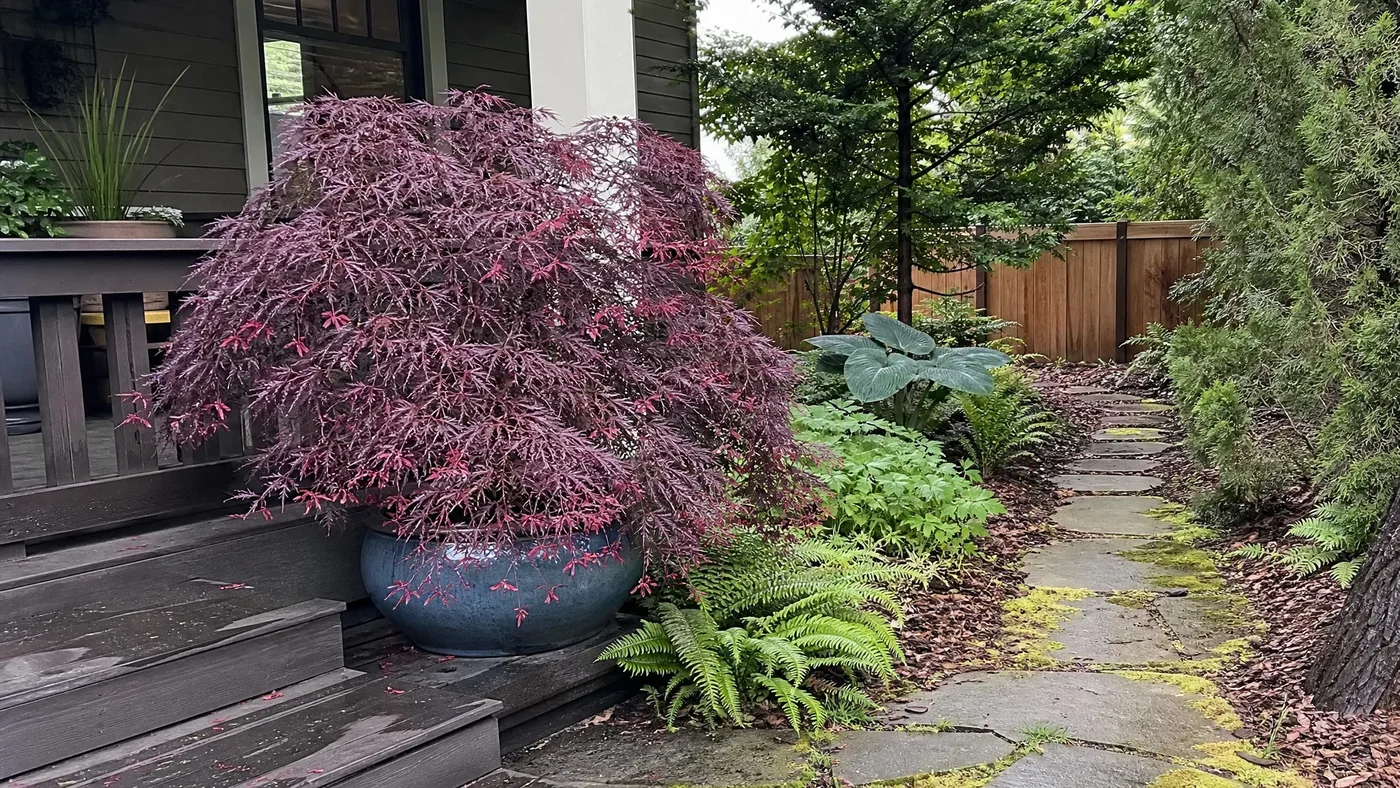
Best Dwarf Japanese Maples for Pots and Containers
The first thing we learned about potted maples is that the tag height tells you almost nothing about how a tree has to be handled. The pot's footprint does. A pallet of potted Dwarf Japanese Maples comes off the truck, and the tall, narrow ones are easy while the low, wide ones hog the floor and tip over if you lift them by the wrong side. Placement on a deck works the same way.
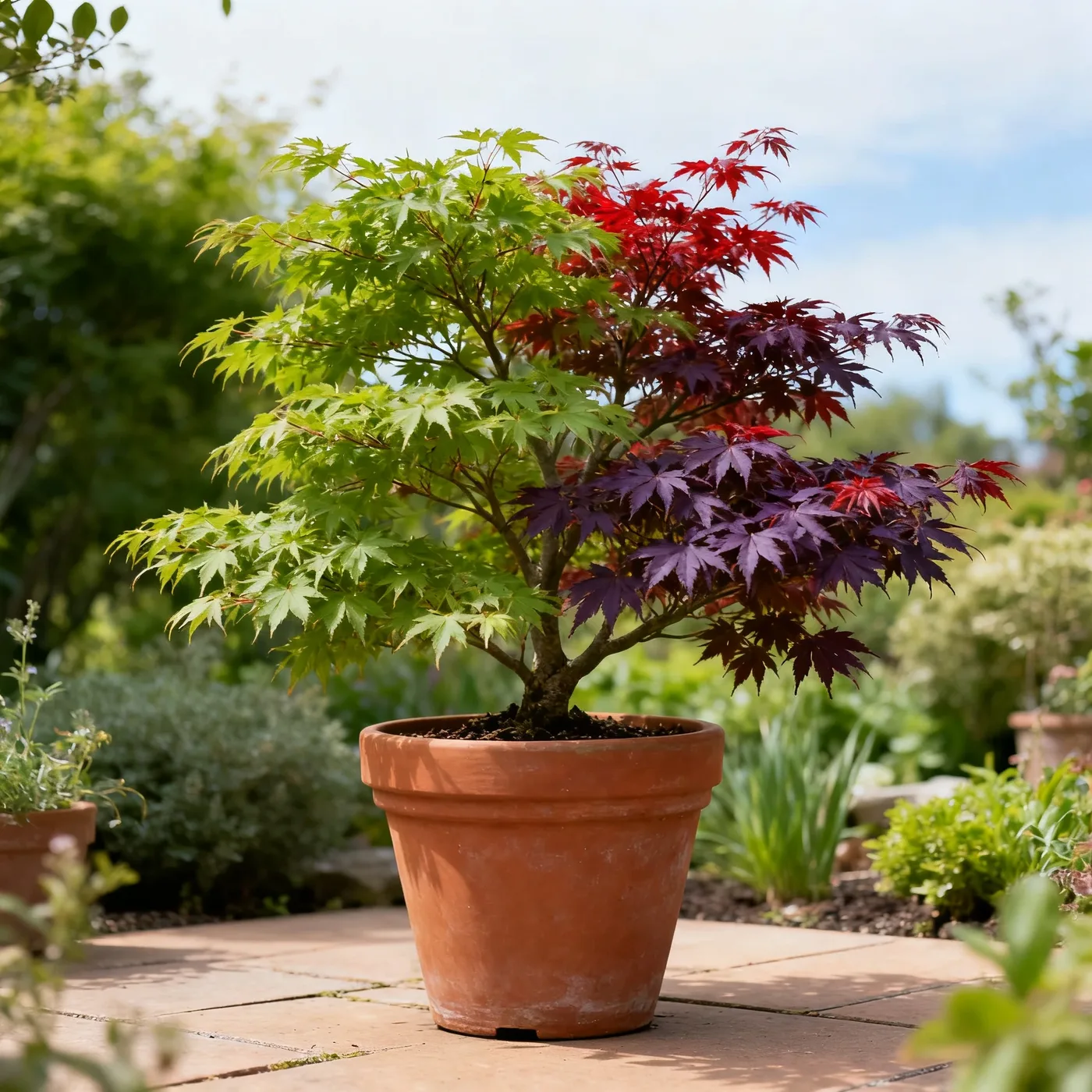
This article talks about which dwarf cultivars suit a pot and answers the questions customers ask us most. Read on to learn how size, pot volume, winter cold, potting mix, upkeep and looks sort Kiyohime, Beni Hime, Shishigashira and Crimson Queen, and which one fits your container.
Chosen well, a Dwarf Japanese Maple stays in its pot for years. Chosen badly, it outgrows the pot in a few seasons and needs constant rescue.
How Big a Dwarf Japanese Maple Gets in a Pot
Take two pots of the same size on a patio, one holding Shishigashira and one holding Kiyohime. After a few seasons the first has grown mostly upward and the second has grown outward, until its branches overhang the rim. Both are called dwarfs, yet they use space very differently, and that is what to judge before you buy.
Published sizes describe a tree in open ground. A pot restrains the roots and therefore the top growth, so treat each figure below as a ceiling, not a forecast. The same pot also changes how the tree sits: a wide canopy on a narrow pot is top-heavy, and wind can tip it.
Kiyohime and Crimson Queen Take the Space
Kiyohime is vigorous and dense, reaching 2 meters (about 6.5 feet) in both height and spread. It has a spreading, branched habit, so the width arrives as fast as the height. Crimson Queen reaches 1.5–2.5 meters in height and spread, which is roughly 5–8 feet.
Those figures are for a tree with free roots. In a pot, expect less, but plan the spot as though you will get close to it.
Verdict: both suit a large pot and a patient owner. Neither is a small-pot tree for the long run, despite the dwarf label.
Shishigashira and Beni Hime Stay Tighter
Shishigashira is a dense bushy shrub of distinctive upright habit. That upright shape is why it takes less floor space than its height suggests, and why it is the easier one to move around a deck. We have no mature figure for it that we would stand behind, so go by the plant tag.
Beni Hime is the same story. We treat it as one of the smaller types and have no published number for it. If you want the very smallest trees, see our guide to the ultra-dwarf types.
Verdict: Shishigashira is the better choice for tight spots, and Beni Hime is a good fit for a modest pot.
Pot Volume Each Dwarf Japanese Maple Cultivar Needs
Most buyers want a gallon figure per cultivar, and we will not make one up. No source we trust gives a pot volume for these four, so any number from us would be invented. What we can give you is the logic, and it works well enough in practice.
Roots need room to spread without circling a wall. The more a cultivar spreads above ground, the more root it needs below. Kiyohime and Crimson Queen, with their wide branching, need the biggest pot you can place. Shishigashira and Beni Hime do well in a medium pot that you step up gradually.
When to Step Up
A tree tells you when it has outgrown a pot. Watch for these signs:
- Roots show at the drainage holes or push up at the surface.
- Water runs straight through and out the bottom without wetting the mix.
- The pot dries out in a day or two in summer when it used to last longer.
- New growth is smaller or thinner than last year's.
Go up one pot size at a time and never jump to a huge pot, because a large volume of wet mix around small roots stays soggy. Our container size guide lists what is sold, and the potting guide shows how to repot.
Verdict: give Kiyohime and Crimson Queen the roomiest pot from the start. Start Shishigashira and Beni Hime smaller and move up.
Dwarf Japanese Maple Hardiness Once Roots Sit Above the Ground
A tree in the ground has the whole mass of soil as insulation. The same tree in a pot has its roots exposed to cold air through the pot wall on every side. Roots freeze harder in a container than they would in a bed, and that is the point most buyers miss when they check a zone map.
The species is listed for USDA zones 5a to 8b. Those are ground ratings. We have no cultivar-specific zone data for the four cultivars here, so none of them can be called hardier than another on paper. For a pot, plan as though you gardened in a colder zone than your map says, and ask your local extension service how much colder.
Pot Size Is Your Insulation
A larger pot holds more soil and buffers cold better, which gives Kiyohime and Crimson Queen a built-in edge. Small pots of Shishigashira or Beni Hime are the ones to move against a house wall or into an unheated garage once hard freezes arrive.
Young leaves are also sensitive to frost, and late frosts can cause damage. A pot is easy to move, and that is your advantage over a planted tree: pull it under cover on a frost night in spring. Our winter care guide covers the details.
Verdict: all four cope in zones 5 to 8 if the pot is sheltered, with the larger pots coping best and the small ones needing protection.
Potting Mix That Drains and Still Holds Water
A maple can die in a pot that never seemed dry, because the mix was heavy and stayed wet around the roots. Maples want well-drained, acidic soil that is high in organic matter, and in a pot the balance is harder to hold because the volume is small.
The ideal is evenly moist, well-drained soil. Crimson Queen does well in acid or neutral soil, so it forgives a little more than the others. We have no pH range for the other three, so stay on the acid side for all of them.
Fit by cultivar comes down to the pot, not the plant. Kiyohime and Crimson Queen in larger pots hold moisture longer, so they can take a mix with a little more bark or grit. Smaller pots with Shishigashira and Beni Hime dry faster and do better with more organic matter. Mix recipes are in our soil guide.
Verdict: every cultivar here wants the same kind of mix. Crimson Queen is the most forgiving, and the small-pot types need the most attention to moisture.
Upkeep Load Across a Dwarf Japanese Maple Season
By midsummer, the trees that need the most attention are not the biggest ones. Small pots dry quickly, and young leaves are not drought tolerant, so a missed day shows up as scorched leaf edges. We have no source giving exact intervals for watering or repotting, so the table compares load in relative terms.
| Cultivar | Watering | Repotting | Verdict |
|---|---|---|---|
| Kiyohime | Steady, large pot holds water | Rarely at first, then needs a big step | Easy once placed |
| Crimson Queen | Steady, fine leaves lose water in wind | Occasional | Easy to moderate |
| Shishigashira | Frequent in a small pot | Regular, small steps | Moderate |
| Beni Hime | Frequent in a small pot | Regular, small steps | Fussiest |
One of the most common questions we get is how often to water. The honest answer is to check the mix with a finger, as our watering guide explains. Move the pot out of drying winds, since these trees need protection from them.
Feeding is light for every one of them. These are slow-growing trees, and over-feeding a slow plant does more harm than skipping a feed. Check the fertilizer label and your local extension service for amounts.
Verdict: Kiyohime is the easiest to keep going once it has room, and Beni Hime in a small pot is the fussiest. The smaller the pot, the more the watering routine decides the outcome.
Leaf Color and Form on a Patio
On a deck, shape counts as much as leaf color. A spreading plant softens a railing or a step edge, while an upright one stands as a vertical accent beside a door. Choose by where the pot goes, then by color.
Crimson Queen has dissected, lacy purple foliage that turns bright scarlet in fall, with red and orange shades in autumn and small purple spring flowers. Shishigashira has masses of small, dark green, lobed leaves that turn soft orange. Kiyohime is the spreading one. We have no sourced leaf-color description for Kiyohime or Beni Hime, so check them in person.
The fine foliage of Crimson Queen looks best where you can see it up close, like a table-height pot. Shishigashira works as a pair flanking steps. If you want red leaves in a compact form, Shaina is described as dense and compact with red foliage.
Placement matters for leaf condition as well. Ideally these trees sit in dappled shade, and an exposed deck edge in hot afternoon sun is where we often see leaf scorch.
Verdict: Crimson Queen is the showpiece, Shishigashira is the tidy accent, and Kiyohime fills space.
Which Dwarf Japanese Maple Fits Which Container?
Put the verdicts in a line and the choice gets simple. This ranking runs from the smallest pot to the largest, with one cultivar for each situation:
- Smallest pot, tight balcony: Beni Hime, with a close watering routine.
- Medium pot beside a door: Shishigashira, upright and compact in footprint.
- Large pot, showpiece spot: Crimson Queen, with lacy foliage and strong fall color.
- Largest pot, open deck corner: Kiyohime, which needs the room.
Whichever you pick, a maple in a pot is a long-term resident, so set it where it will not need to move every year. Moving it for winter shelter is the one exception worth planning for.
Choosing Your Dwarf Japanese Maple for a Pot
Pick by the size of the pot you can place, not by the label on the tree. Match the cultivar to the container, keep the mix on the acid side, and shelter the roots in winter. Do the first day properly, and the rest of the season is easier:
- Unpack the tree on its side only if you must, and lift it by the pot, not the trunk.
- Check the branches and leaves for damage and the mix for moisture.
- Move it to dappled shade, out of wind.
- Set the pot on a level spot where water drains freely.
- Water slowly until it runs from the holes, then let the surface dry slightly before the next watering.
Dwarf Japanese Maple
Nursery-grown Dwarf Japanese Maple in sizes from 2 Gallon, shipped to your door.
From $95.85
Shop Now →Container maples do best with the same care we give them at home, so on our farms we keep each Dwarf Japanese Maple in dappled shade with evenly moist, well-drained soil. We are a small business and we raise our own top-quality trees from start to finish, which is why we like helping people find one that fits a pot. If you have a spot in mind, see what is in stock now.