Can Dwarf Japanese Maples Grow in Full Shade?
Dwarf Japanese maples are prized for their delicate foliage and brilliant fall color, but they come with one non-negotiable requirement: light. If you're hoping to tuck one into a deep shade corner of your garden, the honest answer is no. Dwarf Japanese maples cannot thrive in full shade. But before you abandon the idea, read on. The good news is that these plants are remarkably flexible about what "partial shade" means, and understanding their actual light needs may open up options you didn't realize you had.
Light Requirements: What Dwarf Japanese Maples Actually Need
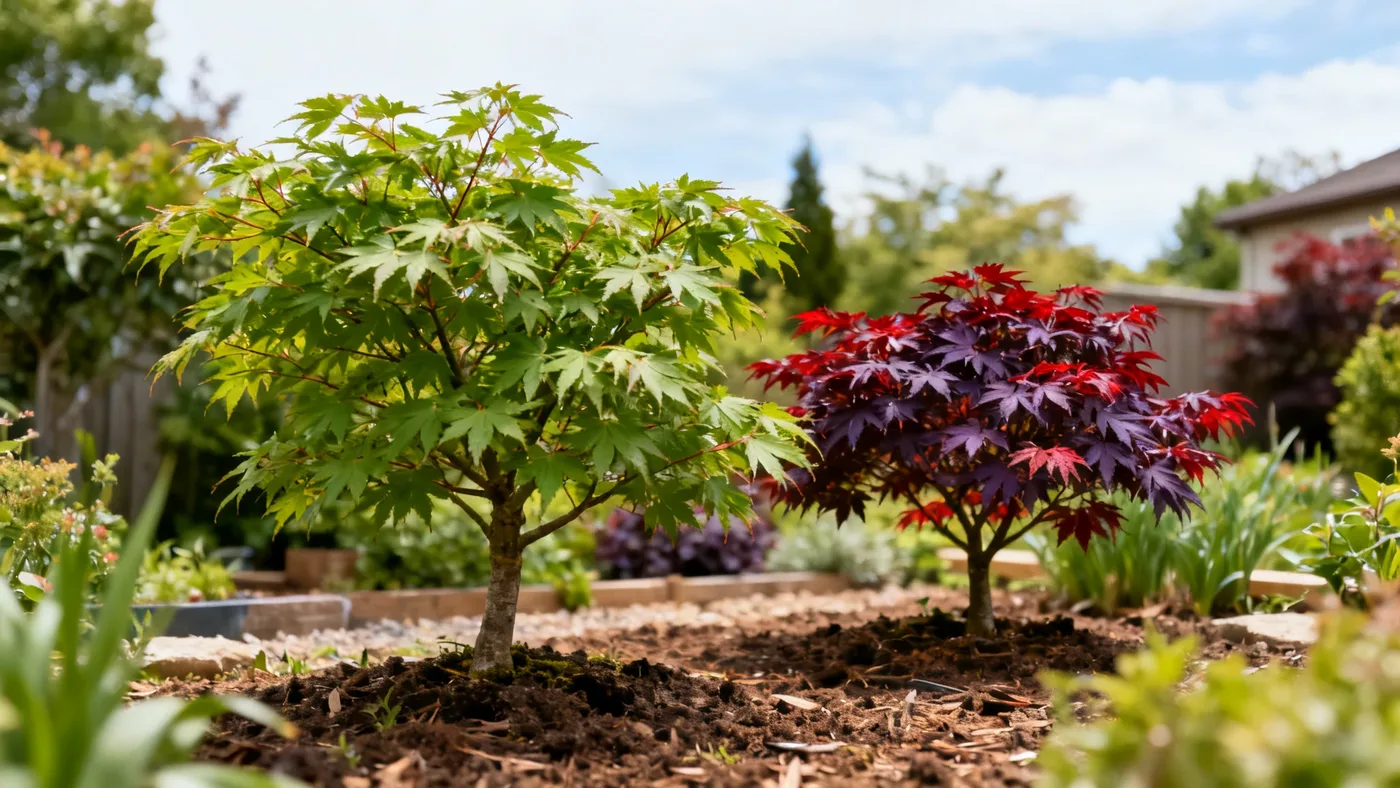
Dwarf Japanese maples (Acer palmatum cultivars such as 'Bloodgood', 'Crimson Queen', 'Tamukeyama', and 'Shaina') require part sun to part shade to grow well. The exact balance depends on where you live and the intensity of your local climate.
In cooler climates and coastal regions (USDA zones 5 to 7), these plants tolerate more direct sun and can handle 4 to 6 hours of unobstructed morning or midday light. In warmer areas (zone 8), afternoon shade becomes essential. Morning sun combined with afternoon protection from 1 p.m. onward prevents leaf scorch, a condition where leaves turn papery and brown from sun and heat stress.
Full shade means six or more hours without direct sunlight each day. In that environment, your dwarf Japanese maple will struggle with three major problems: severely slowed growth, poor fall color development, and increased vulnerability to disease.
Why Full Shade Doesn't Work: What Happens to Your Tree
Dwarf Japanese maples grow slowly by nature, adding roughly 6 to 12 inches per year. In full shade, that growth rate slows further. Without sufficient light, the plant cannot produce enough energy through photosynthesis to fuel development of new foliage and branches. You'll end up with sparse, elongated stems reaching toward whatever light is available, a condition called etiolation. The plant may look thin and ungainly rather than the compact, architectural specimen you envisioned.
Fall color is where shade does the most damage. Dwarf Japanese maples often deliver the standout feature of any garden: brilliant red, orange, or gold autumn foliage. That color is a direct product of sunlight. Maples growing in deep shade often retain green or muted tones through fall, missing the entire ornamental payoff of the plant.
Poor light also invites disease. Anthracnose, verticillium wilt, and other fungal diseases thrive in shaded, humid microclimates where air circulation is poor and foliage stays damp longer. The plant's immune system is also weakened by the stress of insufficient light, making it more vulnerable to aphids, scale, and Japanese beetles.
Container-grown maples face an additional risk in shade: girdling roots. When a tree is confined and stressed by low light, roots can wrap around the base of the stem and eventually cut off the flow of water and nutrients. This slow decline may take several years to become obvious, but it is difficult to reverse once established.
Step 1: Assess Your Planting Spot (The Diagnostic Phase)
Before giving up on a full-shade site, observe it carefully for a full day. Many gardeners think they have full shade when they actually have dappled or partial shade. This assessment is your first critical step.
Track light in your proposed planting location:
- From sunrise to noon: Note whether direct sunlight reaches the spot. If yes, note when it arrives and how long it stays.
- From noon to sunset: Watch for afternoon sun. Even partial sun in late afternoon (after 3 p.m.) can help significantly.
- Quality of shade: Is it dappled shade from tree canopy above, or solid shade from a building or fence? Dappled is far better.
- Reflected light: Does light bounce off a nearby light-colored wall or fence? This counts as useful indirect light.
Here's what to look for after your day-long observation:
- Part sun to part shade (ideal): The spot receives 3 to 6 hours of direct sun, typically with morning sun and afternoon shade, or afternoon sun and morning shade. This is where dwarf Japanese maples thrive.
- Dappled shade: Sunlight is filtered through tree canopy, creating moving patches of light and shadow throughout the day. This is often ideal, especially in zones 8 and warmer.
- High, filtered shade: Shade cast by tall trees whose branches are high enough to allow reflected light and airflow. Maples often accept this if they're not directly under the densest canopy.
- Full shade: No direct sun at any point in the day, with limited bright indirect light. This is the scenario where success becomes very difficult.
If your spot falls into the first three categories, stop worrying. You're in the zone where dwarf Japanese maples thrive. That's not full shade.
Step 2: Choose Your Strategy (If Space Is Truly Full Shade)
If your site assessment confirms full shade, you have four realistic options:
- Relocate the planting spot: Can you plant 5 to 8 feet to the west or east, where the tree may catch morning or late-afternoon sun? Even one or two hours of morning light in the cooler part of the day can make a meaningful difference. This is often the simplest solution.
- Prune overhead trees: If high tree canopy is blocking light, selective pruning of lower branches on nearby trees may allow dappled sun to reach your planting site. Consult a certified arborist before removing large branches. Removing even one major overhead branch can shift a site from full shade to partial shade.
- Plant in a container and manage seasonally: Dwarf Japanese maples are well suited to container culture with good drainage and proper winter root protection in zones colder than 6. You can place the pot in the sunniest spot available during the growing season, then move it to a shadier location or into a protected structure like an unheated garage during winter dormancy. Use containers with drainage holes filled with rich, well-draining loam matching the plant's soil preference of slightly acidic to neutral pH, roughly 5.5 to 6.5.
- Proceed with reduced expectations: If you're committed to a full-shade site, you can still grow a dwarf Japanese maple, but set realistic expectations. Foliage may remain greenish in fall rather than turning brilliant red or gold. Pair it with shade-loving companions that offer their own seasonal features: hostas for texture, hellebores for winter flowers, or dwarf conifers for year-round structure. This turns a limitation into a deliberate design choice.
Step 3: Materials and Setup for Full-Shade Growing
If you decide to attempt growing a dwarf Japanese maple in full shade, gather these materials and prepare your site:
- Soil amendments: compost or well-aged organic matter (2 to 3 bags for an 8 to 12-inch deep planting hole)
- Watering can or soaker hose for consistent moisture application
- Sharp pruning shears for removing diseased or crowded branches
- Slow-release, balanced fertilizer formulated for acid-loving or woody ornamentals
- Disease monitoring kit: fungicide (sulfur-based or neem oil) and insecticide (horticultural soap) for early intervention
- Optional: container with drainage holes and potting soil if attempting container culture
Step 4: Planting and Ongoing Care
- Choose a resilient cultivar: Some dwarf Japanese maple varieties tolerate low light better than others. 'Bloodgood' and 'Shaina' are relatively robust choices. Ask your nursery for their recommendation on the most shade-tolerant dwarf cultivar available.
- Prepare rich soil: Full-shade stress is compounded by poor nutrition. Amend your planting hole with compost or well-aged organic matter to a depth of 8 to 12 inches. The goal is rich, well-draining loam that retains consistent moisture without becoming waterlogged.
- Establish a consistent watering schedule: Shade-grown maples still need moderate, consistent moisture. Check soil moisture weekly during the growing season. Water when the top inch of soil feels dry, but do not let the plant sit in standing water.
- Monitor for fungal disease actively: In shade, vigilance against anthracnose and other diseases is critical. Prune out any leaves showing brown spots or unusual discoloration immediately. Improve air circulation by thinning crowded branches in late fall or mid-winter while dormant.
- Fertilize lightly in early spring: Apply a balanced, slow-release fertilizer formulated for acid-loving or woody ornamentals. Follow package directions for your tree's size. Avoid over-fertilizing, which stresses the plant and encourages tender growth.
- Prune minimally: Light shaping and removal of deadwood in late fall to mid-winter is all that's needed. Do not aggressively prune. The plant needs all its foliage to manufacture energy.
- Check for pests weekly: Japanese beetles, aphids, and scale are more likely to infest stressed trees. Inspect undersides of leaves weekly in summer. Address pests promptly with organic neem oil or horticultural soap applied early.
Common Mistakes to Avoid
- Overwatering: Shade reduces evaporation. Soggy soil invites root rot and fungal disease. Water less often than you would for a sun-grown tree, and always check soil moisture first.
- Fertilizing too heavily: A stressed, shade-grown tree doesn't need extra nitrogen. Overfertilizing promotes weak, disease-prone foliage. Use half-strength or follow the "light feeding" guidance on your product label.
- Ignoring early disease signs: Anthracnose starts small but spreads quickly in shade. Remove affected leaves immediately. Delay increases the chance of whole-branch dieback.
- Planting too deep: Set the tree at the same depth it was in its container. Planting deeper stresses the root system and increases disease risk.
- Giving up after year one: Dwarf Japanese maples grow slowly by nature. A first-year tree in shade may look minimal. Give it 2 to 3 years before deciding it won't work.
Expected Results: What to Realistically Expect
If you plant a dwarf Japanese maple in full shade and follow best practices, here's what may happen:
- The plant may survive and grow slowly. Growth will be slower than sun-grown specimens, potentially 4 to 8 inches per year instead of the typical 6 to 12 inches.
- Foliage will be present but may appear more muted or greenish, especially in fall. Brilliant reds and oranges are unlikely to develop.
- The distinctive architectural branching structure may be less pronounced. The overall silhouette may be looser or less dense than a sun-grown specimen.
- Fall color may be delayed or subdued. Peak color typically occurs in mid-October to mid-November depending on region and cultivar. In shade, this shift may occur later or remain pale.
- You may observe occasional pest or disease spots, requiring more active management than a sun-grown tree would need.
- The plant may reach mature height (typically 4 to 8 feet for dwarf cultivars) over a longer timeframe. A shade-grown specimen might take 7 to 12 years versus 5 to 10 years for a sun-grown tree.
None of these outcomes is catastrophic. But they do represent a step down from the full ornamental potential the plant offers in partial shade with morning sun and afternoon protection.
Quick Reference: Shade Levels and Suitability
| Light Condition | Hours of Direct Sun | Suitability | Expected Performance |
|---|---|---|---|
| Part sun (morning or late afternoon) | 3 to 6 hours | Ideal | Strong growth, brilliant fall color, minimal disease. No compromises needed. |
| Dappled or high shade | 2 to 4 hours filtered | Good (zones 5 to 7) | Good growth, fall color slightly muted but still attractive. |
| Morning or late sun with midday shade | 2 to 4 hours, cooler time of day | Good to acceptable | Avoids heat stress. Works well in zones 5 to 7. |
| Full shade | 0 direct hours | Not recommended | Slow growth, muted color, higher disease risk. Proceed only with adjusted expectations. |
For detailed year-round care, see our complete dwarf Japanese maple care guide.